

If you have ever sat with two browser tabs open, one for Claude and one for Gemini, wondering which one deserves your next hour of work, you are in good company. The short answer: Claude is usually the better pick for careful writing, editing and following detailed instructions, while Gemini is usually the better pick for live research, Google Workspace and audio, video and image work. For most affiliate marketers, the smartest move is not choosing a winner. It is giving each tool the job it does best.
Below, we walk through what each one is, where they differ, what they cost, and how to test them on your own content so you are not relying on anyone’s opinion, including ours.
TL;DR
- Choose Claude for long-form writing, voice consistency, editing and agentic coding. Choose Gemini for fresh web research, multimodal inputs and Google-heavy workflows.
- In one 2026 hands-on test, Claude’s drafts needed less editing for marketing writing, while Gemini needed less editing for competitor-pricing research.
- Both offer 1M-token context on their flagship models, so context size alone rarely decides it anymore.
- Plans and API prices change often. Check the official pricing pages before you commit, and run a real task through both first.
- Whatever you pick, a human still reviews every claim, link and disclosure before anything gets published.
Table of Contents
- Which versions are we actually comparing?
- Claude vs Gemini at a glance
- Writing and editing: where Claude tends to pull ahead
- Research and freshness: where Gemini earns its place
- Context, reasoning and multimodal input
- What do they cost?
- What about Claude 3 vs Gemini 1.5?
- How to test them on your own work
- A simple way to use both
- Our perspective
- Want help building your AI workflow?
- FAQ
- Sources
Which versions are we actually comparing?
People search “claude vs gemini” as if each were a single product. They are not. Each is a family of models that gets refreshed several times a year, so the first thing to do is pin down what you are comparing.
Anthropic’s models overview describes a lineup in tiers: Claude Fable 5.1 for demanding reasoning and long-horizon agentic work, Opus 5 for complex agentic coding and enterprise work, Sonnet 5 for a balance of speed and intelligence, and Haiku 4.5 as the fastest model with near-frontier intelligence.
On Google’s side, the Gemini 4 Argon documentation lists it as the current flagship as of October 2026. Google also still documents the earlier Gemini 3.1 Pro, which it describes on its model page as a multimodal reasoning model for complex tasks, agentic work, coding and long-context understanding.
Why does this matter to you? Because many articles you will find, including some ranking right now, compare models that are a generation or two old. A verdict about Claude Sonnet 4 against Gemini 2.5 Pro tells you very little about today’s tools. When you read any comparison, check which versions it tested and when.
Claude vs Gemini at a glance
Here is the quick view before we go deeper. Keep in mind that the right column is about fit, not about one tool being flatly better.
| Area | Claude | Gemini |
|---|---|---|
| Best known for | Careful writing, instruction-following, agentic coding | Real-time web research, multimodal input, Google Workspace |
| Context window | 1M tokens on most current models, 200K on Haiku 4.5 | 1M tokens on Gemini 4 Argon and Gemini 3.1 Pro |
| Input types | Text and image | Text, image, video, audio and PDF |
| Consumer plans | Free, Pro, Max | Check Google’s current plan page |
| Typical marketing use | Drafts, rewrites, brand voice, long documents | Fresh research, competitor checks, repurposing media |
The context and input details come from Anthropic’s models overview and Google’s Gemini 3.1 Pro page. The strengths row reflects how those capabilities show up in everyday affiliate work.
Writing and editing: where Claude tends to pull ahead
If your day is mostly emails, review drafts, product descriptions and long posts, writing quality is the thing you will feel most. This is where Claude has built its reputation.
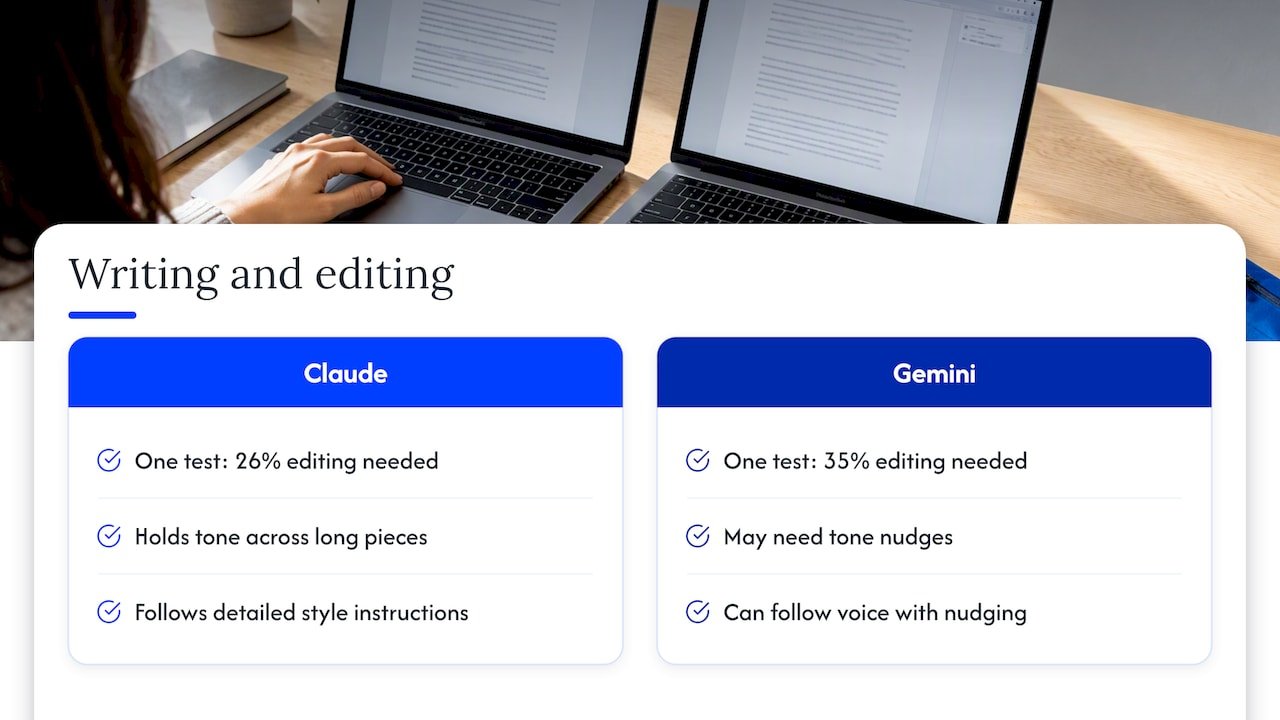
One 2026 hands-on comparison from TheBizAI measured how much editing each tool’s output needed. Across writing tasks such as customer emails, product descriptions and long-form pieces, Claude averaged 26% editing versus 35% for Gemini. That is one test with one set of prompts, not a universal benchmark, so treat it as a signal and not a law. But it matches what many marketers report: Claude holds a tone across a long piece and follows detailed style instructions more faithfully.
That matters if you have a brand voice you care about. If you hand Claude a short voice guide, two sample paragraphs and a brief, it tends to keep the thread from the first paragraph to the last. Gemini can do this too, but you may find yourself nudging it back more often.
We go much deeper on the practical side in our guide to using Claude for marketing as an affiliate. And if the real bottleneck is that your drafts sound generic no matter which tool you use, the fix is usually in the input, which is what our AI brief templates are for.
One honest caution applies to both. Anthropic’s own model card documentation says Claude models suit writing, editing, outlining and summarizing, but can hallucinate and should get human review. That is a good rule for affiliate content in particular, where a wrong price, feature or earnings claim can cost you trust and, in some cases, run you into trouble with disclosure rules.
Research and freshness: where Gemini earns its place
Here the picture flips. The same TheBizAI test found Gemini needed less editing for competitor-pricing research, 28% versus 41% for Claude. Gemini also sits inside Google’s ecosystem, and Google lists Search as a tool for Gemini 3.1 Pro, which suits questions like “what changed in this program’s commission structure this month?”
For an affiliate marketer, that translates into jobs like checking what competing reviewers are saying, scanning current offers, summarizing a fast-moving niche, or pulling together a first pass on a product category you have not covered before. You still verify every figure against the program’s own page, but starting from fresher information saves time.
Gemini is also the more natural fit if your team lives in Gmail, Docs and Sheets. When your content calendar, keyword sheet and drafts are already in Google’s tools, keeping the AI in the same place removes friction, and friction is what kills consistent publishing.
There is a second research angle worth knowing about. More readers now get answers from AI search instead of clicking ten blue links, so how your pages show up inside Gemini matters. A Gemini ranking tool can help you see how your content is being surfaced there, and our GEO playbook for ranking in AI answers covers the moves we would make first.
Context, reasoning and multimodal input
A few years ago, context size was the headline difference. In the 2024 Gemini 1.5 technical report, Google reported recall above 99% in long-context tests up to 10 million tokens and contrasted it with the 200,000-token context of Claude 3 at the time. That gap has largely closed for flagship models. According to Anthropic, most current Claude models have a 1-million-token context window and up to 128K output tokens, with Haiku 4.5 the exception at 200K context and 64K output. Gemini 4 Argon also offers a 1M-token context, with a 32K non-streaming and 64K streaming output cap.
What does that mean in practice? You can drop an entire course transcript, a stack of competitor pages or a full year of newsletter issues into either tool. Output length is where Claude’s larger cap can help if you want a very long document in one go, though most of us write in sections anyway.
Reasoning is increasingly something you dial. Gemini 4 Argon supports low, medium and high thinking levels, so developers can trade speed for depth. Anthropic positions its higher tiers, like Opus and Fable, for demanding reasoning and agentic work.
The clearest practical difference is input type. Anthropic states that current Claude models take text and image input. Google lists text, image, video, audio and PDF input for Gemini 3.1 Pro. If you want to hand the AI a YouTube-style video or a podcast recording and ask for a summary or clip ideas, Gemini is the natural starting point. If you are working mostly in text, that advantage may never touch your day.
On coding, Anthropic describes Opus as built for complex agentic coding, and many developers favor Claude for it. Affiliate marketers who write small scripts for tracking links, spreadsheets or automations may notice this, but it is rarely the deciding factor unless you build tools.
What do they cost?
There are two separate price questions here: the plan you pay for as a person, and the API price if you build automations.
On the consumer side, Anthropic’s Claude page lists a Free plan at $0, Pro at $20 monthly or $200 billed annually, and Max starting at $100 monthly with 5x or 20x Pro usage. Paid plans add capabilities such as Claude Code, Research and additional models. For Gemini’s consumer plans, go to Google’s own plan page, since bundles and tiers there change frequently and are often tied to Google’s other subscriptions.
On the API side, the numbers are more explicit. Anthropic lists $10 per million input tokens and $50 per million output tokens for Claude Fable 5.1, and $5 and $25 for Opus 5. Prompt cache reads for Fable 5.1 cost 2.5% of the base input price. Google lists Gemini 4 Argon at an introductory $2 input and $10 output per million tokens, doubling to $4 and $20 after the introductory period, with implicit caching that discounts cached input by 95%.
So on paper, Gemini is cheaper per token, and that is a real advantage if you run high-volume automations. But the cheapest tool is not always the cheapest workflow. If one model needs 35% editing and another 26%, your time is the bigger cost. Tomako’s marketing workflow guidance makes a similar point: calculate the full cost, including seats, usage and plan tier, and count the corrections, not just the subscription.
What about Claude 3 vs Gemini 1.5?
If you landed here searching for those older versions, a quick reality check. Google’s lifecycle page says Gemini 1.5 Pro and Flash became unavailable to new projects without prior usage from April 29, 2025, while Claude 3 Opus was deprecated June 30, 2025 and scheduled to shut down January 5, 2026. That page covers Google Cloud’s Vertex AI offering, so availability elsewhere may differ, but the direction is clear.
The lesson is simple: comparisons of those models are history. Use them to understand how the race started, such as Gemini’s early push on very long context, but make buying decisions on current versions.
How to test them on your own work
You can read comparisons all day, and you will still not know which tool suits your voice, your niche and your patience. A small test fixes that, and it takes about an hour.
Pick one real deliverable you need anyway, such as a 1,200-word product review, a comparison table or an email sequence. Write one clear brief with the same inputs, the same voice notes and the same facts, and give it to both tools. Tomako’s guidance is to test a real task with real inputs and count the inaccuracies and corrections. Do exactly that. Mark every sentence you had to fix and note why: wrong fact, wrong tone, filler, or structure.
Then do a second round with research. Ask both for the current commission terms, features and pricing of a program you know well, and check the answers against the program’s own page. You will learn quickly which tool you trust for facts and which one you trust for phrasing.
Finally, check the handoff. Does the output paste cleanly into your editor? Do the links work? StoryLab.ai’s marketing-operations guidance recommends human-in-the-loop checks for source verification, brand voice, claim boundaries, disclosure needs, link integrity and final signoff. For affiliates, disclosure and claim boundaries are the ones that can hurt you most, so make them a checklist item every time. Our piece on EEAT for affiliate sites and FTC steps shows how we handle that.
If you want a ready-made starting point, our affiliate marketing prompts work in either tool, so you can compare them on equal footing.
A simple way to use both
You do not have to marry one tool. A split that many marketers settle into looks like this: use Gemini to gather and sanity-check the current picture, then move the verified notes into Claude to shape the draft, keep the voice and tighten the edit. Then you, the human, do the final read.
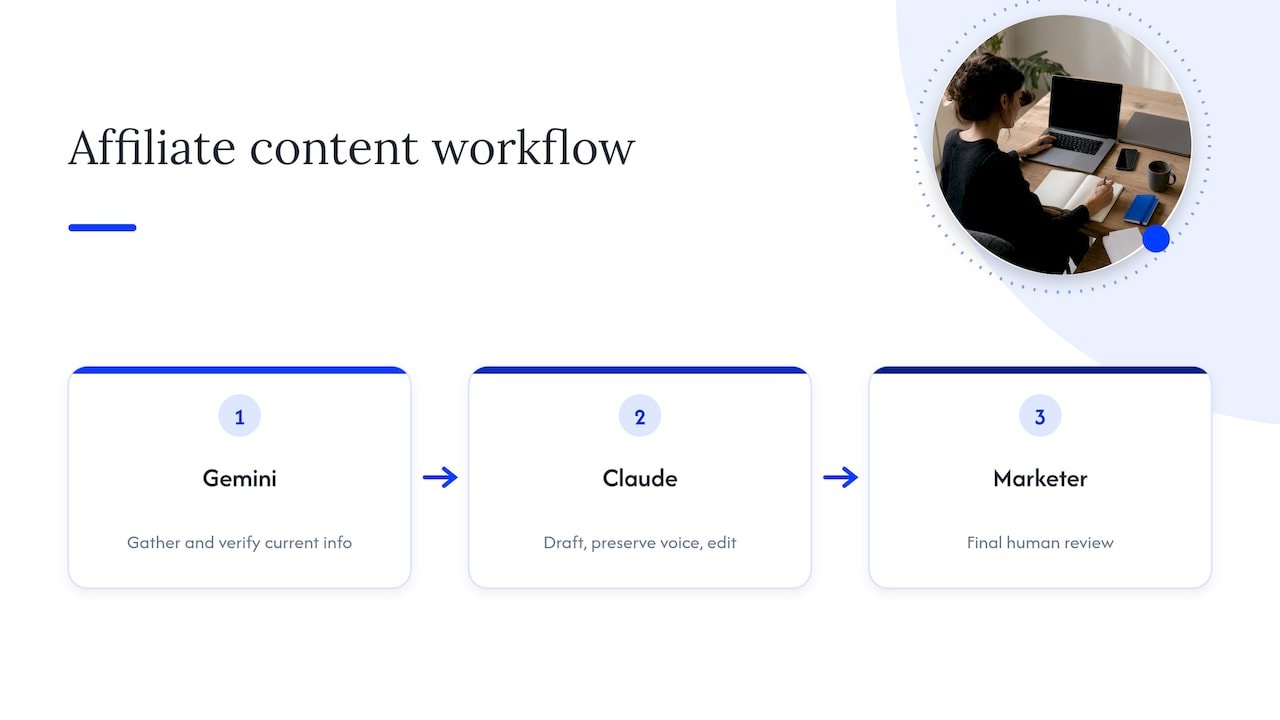
That hand-off works best when it is written down. If you plan a whole campaign this way, a marketing campaign workflow can help you map who or what does which step, from brief to approval queue to publishing. For affiliates specifically, our guide to AI workflow automation shows where automation helps and where it should stop.
One more thing about voice. Whatever model drafts it, readers can tell when copy feels flat. A pass for personality, real examples and your own experience makes the difference, and our walkthrough on how to humanize AI content gives you a quick workflow for it.
Our perspective
We get asked this question a lot, usually with a little tension behind it. People want permission to stop researching and start publishing. So here is how we see it.
We lean on Claude for the work that has to sound like a person: drafts, rewrites, the email you actually want to send. It is patient with long instructions, and that fits how we teach, with context first and a clear ask second. We reach for Gemini when the question is “what is happening right now,” or when the source material is a video or an audio file. Neither replaces your judgment about what your audience needs.
The bigger risk is not picking the wrong model. It is skipping the review step because the output sounds confident. Every tool in this space can be wrong with a straight face, so we check prices, claims and disclosures against primary sources every time. If you are just starting out, pick one tool, learn it well for a month, and then add the second. Depth beats collecting subscriptions.
And go easy on yourself. Perfecting the tool choice is a very comfortable form of procrastination. A decent workflow you actually run beats a perfect one you keep researching.
— Will
Want help building your AI workflow?
If you would rather not figure this out alone, that is exactly what we do here. We share coaching, tips, video tutorials, tool recommendations and a newsletter built for affiliate marketers learning to use AI. Start with our best AI writing tools for marketers and creators, or come say hello on the Will Buckley homepage and pick the path that fits where you are.
FAQ
Which is better, Claude or Gemini?
It depends on the job. Claude generally wins on careful writing, voice consistency and agentic coding, while Gemini generally wins on fresh web research, multimodal input and Google Workspace integration. If you can only pick one for affiliate content, choose the one whose output needs the least editing on your own test task.
Is Claude better than Gemini for writing?
For most marketing writing, yes, that is the common finding. In TheBizAI’s 2026 test, Claude’s drafts averaged 26% editing against 35% for Gemini. It is one test, so run your own with your own voice guide before you decide.
Is Gemini cheaper than Claude?
On API token prices, Gemini 4 Argon is listed lower than Claude’s top models, though its rate is introductory and doubles later. For consumer plans, compare Anthropic’s and Google’s current pricing pages. Remember to count your editing time too, since a cheaper draft that needs more fixing is not always cheaper.
Can I use both Claude and Gemini together?
Yes, and many marketers do. Use Gemini for current research and media inputs, verify the facts, then bring them to Claude to draft and edit. Keep a human review step before publishing either way.
Do Claude 3 and Gemini 1.5 still matter?
Not for new projects. Google’s lifecycle page shows both families being retired or restricted, so base your decision on current versions and check availability on the official pages.
Sources
- Anthropic models overview
- What’s new in Gemini 4 Argon
- Gemini 3.1 Pro, Google DeepMind
- Claude consumer plans and features
- Gemini vs Claude for Business: 2026 Test, TheBizAI
- Model Card and Evaluations for Claude Models
- Gemini 1.5 technical report
- Model deprecations, Google Cloud Vertex AI
- AI Marketing Workflow Tools for 2026, Tomako
- Scaling Marketing Operations with AI Assistants, StoryLab.ai