

Twitter affiliate marketing means sharing affiliate links in your posts, bio and replies, then earning a commission when someone clicks or buys through them. Most people still call the platform Twitter, even though it is now X, and the mechanics are the same. You can start with a free account and no website. What decides whether you earn is trust: a clear niche, helpful posts, honest disclosure and links you can track.
Have you ever posted a link, watched it get ten impressions and wondered what everyone else knows that you don’t? Usually it isn’t a secret. It’s a pattern, and this guide walks you through it step by step, with AI doing the heavy lifting where it genuinely saves time.
TL;DR
- Pick one narrow topic, join two or three programs that fit it, and put your best link in your bio before you post anything.
- Teach first and promote second. A common guideline is about 20% promotional posts and 80% useful ones.
- Disclose every affiliate link clearly in the post itself. The FTC does not accept disclosures buried in a profile page.
- Use AI to plan, outline and repurpose, but add your own experience before anything goes live.
- Give every link its own tracking tag so you know which posts earn and which only collect likes.
Table of Contents
- How affiliate marketing on X actually works
- Set up your profile like a tiny landing page
- Choose affiliate programs that fit your audience
- Build an audience by teaching first
- Use AI to plan and sharpen your posts, not to replace you
- Disclose every affiliate link, in the post itself
- Track what earns, then do more of it
- Should you pay for ads or paid features?
- Our perspective: slow and honest wins on X
- Where to go from here
- FAQ
- Sources
How affiliate marketing on X actually works
The idea is simple. A company gives you a unique link. You share it. When someone clicks and takes the action the program rewards, you get paid. Forbes describes it as sharing product links and earning commissions on sales from referrals, with income depending on commission rates and sales volume.
The FTC notes that affiliates typically earn either for referring people to a merchant’s site or for sales generated through their links. In the case it described, the commission was 20% to 45% of the purchase price. That is a real-world example, not a promise of what you will earn.
On X, your links can live in three places: inside posts, in your bio, and in replies or threads. A guide from an affiliate tracking platform lists tweets, profile bios and descriptions as the usual spots. Each one does a different job, which we’ll cover below.
A quick note on “affiliate badges”
If you search this topic you may run into X’s own affiliate badges. They are a different thing entirely. They let an organization show that an account, such as an employee or a franchise, is officially connected to it, and they help protect against impersonation. They are a Premium Business feature and have nothing to do with earning commissions. You don’t need one to do affiliate marketing.
What you can realistically earn
Commission rates vary widely. The same strackr guide says typical rates run from 2% to 12% depending on the product’s price, with some programs paying 50% or more per sale. Physical product programs tend to sit at the low end, and software and digital products tend to sit higher, which is one reason many X affiliates lean toward tools and courses.
That difference matters more than follower count. A 3% commission on a $20 item pays 60 cents. Even a modest recurring software commission can beat that many times over. Think about what your audience already wants to buy, then work backward to the programs.
Set up your profile like a tiny landing page
Your profile is the one piece of real estate that works while you sleep. Before you post a single affiliate link, make sure a stranger can answer three questions in five seconds: who is this, what will I learn here, and where do I go next?
Name and bio. Say what you help people do. “I test AI tools for affiliate marketers and share what works” beats “Marketer. Dreamer. Coffee lover.” Keep it specific, because specific accounts get followed.
Link. Use your bio link for your single best offer, or for a page you control that lists your recommendations. If you point to an affiliate link directly, say so in the bio, for example with a short line like “links may be affiliate links”. That alone won’t cover you for individual posts, but it sets the tone honestly.
Pinned post. Pin a helpful thread, not a sales pitch. Your pinned post is the first thing a new visitor sees after your bio. A short how-to that solves one problem tells people you’re worth following.
Images. If you use photos or screenshots in posts, be sure you have the right to use them. Small teams get caught out by this more often than you’d expect, and this overview of image licensing settings is a useful way to understand what to check before you share visuals publicly.
Choose affiliate programs that fit your audience
The biggest mistake new affiliates make is joining forty programs because they’re free to join. Pick two or three and learn them well.
Check these things on each program’s own terms page before you promote:
- Whether the program allows promotion on social media. Some restrict it or require approval of each channel.
- Commission structure. Is it a one-off payment or recurring? Is it a flat amount or a percentage?
- Cookie or attribution window. This is how long after a click you can still get credit. It varies a lot, and it matters because X users often click now and buy later. Our guide to cookie duration for affiliates explains what browsers do to these windows.
- Payout threshold and schedule. Know how much you must earn before you get paid.
- Link rules. Some programs ban shortened links, link cloaking or paid ads. Read before you build a habit.
Directory sites publish figures such as the median commission for programs aimed at social creators. Treat those as a rough orientation only and confirm the real numbers on the program’s own page.
If you already have an audience and a program wants you, you have some leverage. We wrote a 90-day pilot approach to negotiating commission that you can copy.
Build an audience by teaching first
Here is the honest truth about X: nobody opens the app hoping to see your link. They come for news, jokes, opinions and answers. Your job is to be useful enough that, when you do mention a tool, it feels like a continuation of the help you’ve already given.
A widely repeated guideline, found in Hootsuite’s social strategy guide, is to keep promotional posts to about 20% of your content and let the other 80% inform, educate or entertain. It’s a guideline, not a law, but it’s a good check on yourself. If your last ten posts were all links, you’re a billboard.
A platform that publishes affiliate how-tos calls the best approach “teaching first”: the link is a tool that solves a problem you’ve already named in a helpful post. We agree with that, and it matches how content marketing for ecommerce works more broadly: useful content earns the attention that promotion later converts.
Post types that work
You don’t need to invent a new format. Rotate through a few and see which your audience responds to.
The problem-solution thread. Name a specific problem (“my email open rates dropped”), walk through three or four steps, then mention the tool you used in the last post, with your disclosure.
The honest review. Share what you tested, what worked, what didn’t and who the tool is not for. Readers trust a review that includes a flaw far more than one that glows.
The screenshot post. Show a real workflow, dashboard or before-and-after. Real material beats stock images.
The reply. Watch for people asking “what do you use for…?” in your niche. A short, genuine answer with a disclosed link is often your highest-converting post, because it answers a question someone just asked.
The opinion post. No link at all. These build the personality that makes your recommendations believable.
A simple weekly rhythm
What does this look like in practice? Something like five to seven useful posts a week, one thread, a handful of thoughtful replies on larger accounts in your niche each day, and one or two posts with an affiliate link. You can adjust the numbers, but keep the proportion.
Use AI to plan and sharpen your posts, not to replace you
AI is a great assistant for X, because the platform rewards consistency and short writing, and both are tedious to do by hand. Here is where it earns its keep.
Topic planning. Paste in your niche and the questions your audience asks, and ask for thirty post angles. You’ll throw away half, and the other half will save you an hour.
Thread outlines. Give it a tool you’ve actually used and your notes. Ask for an outline, then write the thread in your own voice. Our prompt engineering workflows for affiliates show how to get drafts that need less cleanup.
Repurposing. One blog post or video can become a thread, three single posts and a reply bank. See our roundup of AI content repurposing tools for options.
Scheduling and routine. Batch the work on one day a week. Our piece on AI workflow automation for affiliate marketers covers how to string these steps together.
Keeping it accurate and authentic
AI can state things confidently that are simply wrong: a feature the tool doesn’t have, a price that changed, a commission rate you invented in your head. Before any post goes out, check every claim against the product’s own page, and add something only you can add: what you tried, what happened, what surprised you. We call this the evidence habit, and it’s the heart of why the evidence pack comes first for AI content.
If a draft sounds flat or generic, our guide to humanizing AI content gives you a quick pass to make it sound like you. And if you want a broader frame for responsible use, see how we map ethical AI marketing to NIST, IAB and UNESCO.
Disclose every affiliate link, in the post itself
This is the part that protects you and your readers, so it deserves your full attention. The following describes United States rules. If you or your audience are elsewhere, check your own country’s advertising rules too.
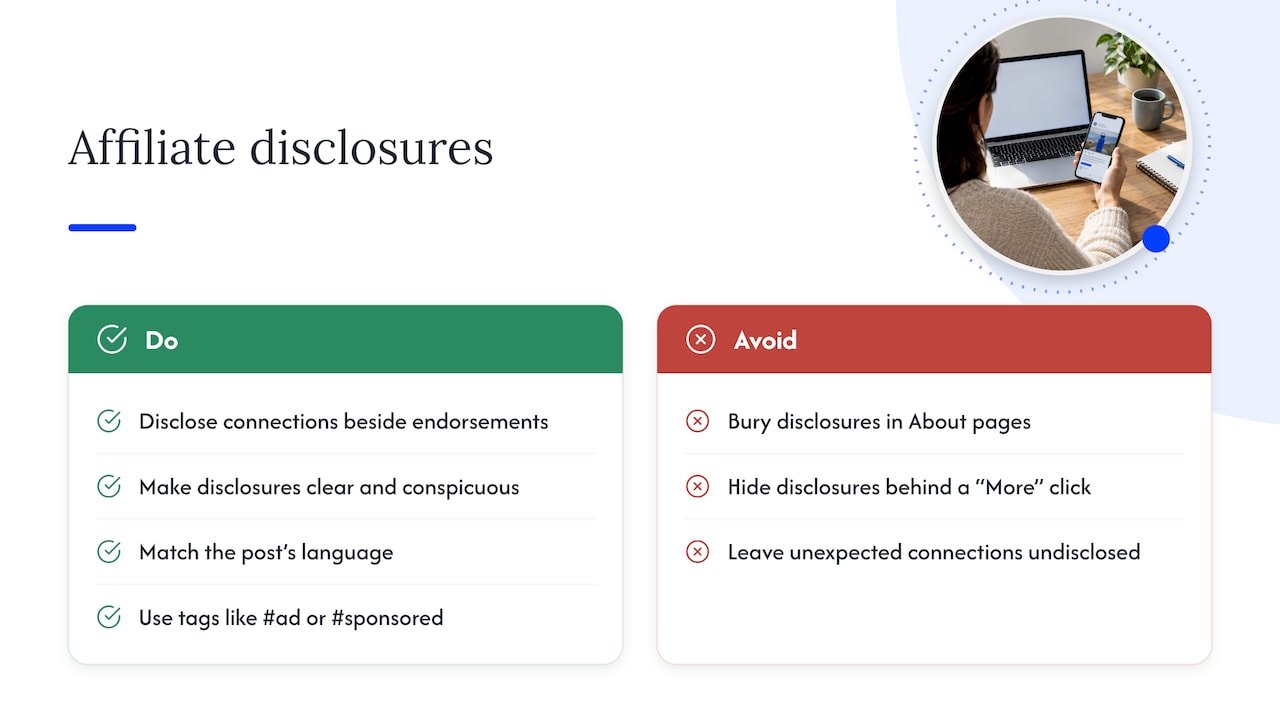
The FTC’s guide for social media influencers says you must disclose any material connection with a brand, whether financial, employment, personal or family, clearly and conspicuously alongside the endorsement itself. It warns against burying disclosures in an About page or behind a “More” click, and says the wording should match the language of the post and be easy to understand. Tags such as #ad or #sponsored are examples it gives.
The FTC also says truth-in-advertising law applies in all media, including social media, and that connections the audience wouldn’t expect should be disclosed. The reasoning is plain: people can’t judge how much weight to give a recommendation if they don’t know you’re paid when they buy.
This isn’t theoretical on X. In a 2017 enforcement action involving a gambling site, the FTC treated undisclosed financial relationships in promotions on Twitter and other platforms as deceptive.
What this looks like in a post
Put the disclosure at the start or near the link, not at the end of a long thread where it’s easy to miss. Plain words work best: “Affiliate link: I earn a commission if you buy.” Tack it on to every post that has a link, including replies. For wording you can copy, see our affiliate disclosure examples, and for the bigger picture of trust signals, our EEAT for affiliate sites guide covers the FTC steps in more depth. If your situation is complicated, a lawyer who knows advertising law is the right person to ask.
Also read X’s own rules and each program’s terms. Platforms and programs can change what they allow, so check the current versions instead of relying on an old thread.
Track what earns, then do more of it
Likes feel great and pay nothing. The only way to know which posts earn is to give each link its own identifier. Most affiliate networks let you add a sub ID or tag to your link, and if you control a landing page you can add UTM parameters.
A simple system: name every link by platform, topic and post type, such as x-thread-email-tool or x-reply-email-tool. After a few weeks, compare clicks and commissions by tag. You’ll probably find that replies and honest reviews outperform your cleverest threads. That’s useful, because it tells you where to spend your time.
For a deeper setup, our guide to affiliate link tracking without cookies shows how to build a setup in about an hour, and the Google Tag Manager walkthrough for affiliates covers click tracking step by step. When you start seeing results, affiliate attribution models will help you understand which touchpoints deserve credit, since a buyer might see three of your posts before clicking.
Metrics worth watching
Watch five numbers: link clicks, click-to-sale rate, earnings per click, which post type drove them, and refunds or cancellations. Earnings per click is the most honest one. It tells you whether a program really suits your audience, no matter how big or small that audience is.
Should you pay for ads or paid features?
Not at the start. Organic posting costs only time, and it teaches you what your audience cares about. Ads make sense only once you know a post already converts and the commission per sale leaves room after ad costs. Check each program’s terms first, because some forbid paid traffic or bidding on their brand name.
On X’s own creator payouts, the rules have been shifting. X’s help page says that Creator Revenue Sharing stopped accepting new members in August 2026 and is being replaced by an Original Content Rewards program with its own eligibility requirements. Read the current page before you plan around it. Think of any platform payout as a bonus, and your affiliate income as something you build on your own terms.
Our perspective: slow and honest wins on X
We’ve coached and taught for a long time, and the pattern repeats on every platform. People arrive wanting a shortcut, and the ones who last are the ones who fall in love with helping. Twitter affiliate marketing isn’t any different. It’s tempting to chase the “$500 a day” promises that fill search results, but we haven’t seen a shortcut that outlasts an audience’s patience.
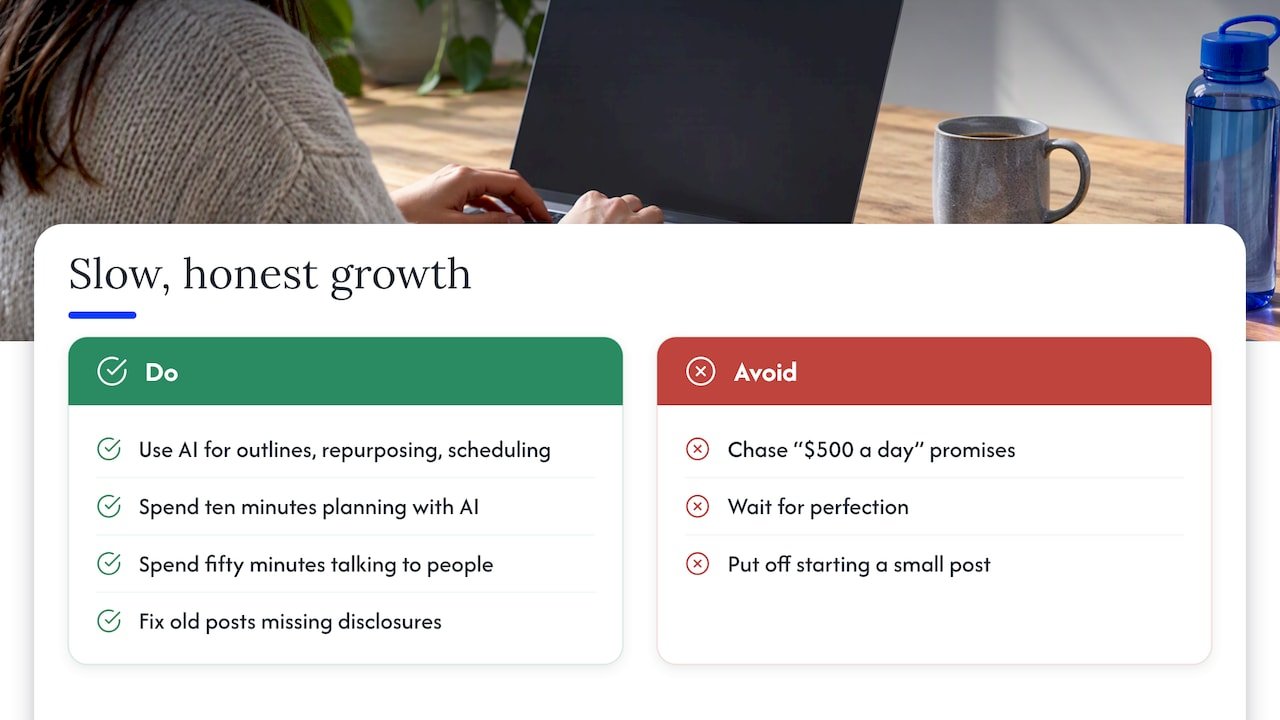
What we do believe in is using AI to remove the boring parts, such as outlines, repurposing and scheduling, so you have more energy for the human parts: replying to a stranger’s question, testing a tool properly, telling the truth about it. If you only have an hour a day, spend ten minutes planning with AI and fifty talking to people.
One more thing. If you slip, miss a week, or realize an old post lacked a disclosure, you haven’t failed. Fix it, move on, and keep going. Consistency matters more than perfection, and procrastination loses its grip once you start with a single small post today.
— Will
Where to go from here
If you’d like a guided path for adding AI to your affiliate workflow, start with our AI content strategy 90-day rollout, or browse everything at Will Buckley’s site for coaching, tutorials and the newsletter. And if X isn’t the only place your audience hangs out, our playbooks for LinkedIn and Reddit are good next steps.
FAQ
How do I make money from Twitter (X) with affiliate marketing?
Join affiliate programs that fit one niche, share helpful posts and threads, and include your tracked affiliate link where it solves a problem. You earn a commission when someone clicks and completes the qualifying action. Disclose the link in the post itself.
How much does X pay per 1,000 views?
There is no fixed rate. X’s creator payout programs have eligibility rules and have been changing, so check the current help page. Affiliate commissions work differently, because you are paid per qualifying action, not per view.
Do I need a website for Twitter affiliate marketing?
No. You can place affiliate links in posts, replies and your bio, provided the program allows social media promotion. A simple page you control does give you more flexibility, such as a list of recommendations and better tracking.
Do I have to disclose affiliate links on X?
In the United States, yes. The FTC says material connections must be disclosed clearly and conspicuously with the endorsement itself, not hidden in a profile. Use plain words such as “affiliate link, I earn a commission” or a clear tag like #ad.
Are X affiliate badges the same as affiliate marketing?
No. Affiliate badges show an official connection between an account and an organization, and they are part of X’s Premium Business features. They don’t earn you commissions.
Sources
- How To Make Money On X (Twitter) – 5 Ideas, Forbes
- FTC: deceptive endorsements case, 2011
- Complete Guide to Twitter Affiliate Marketing, Strackr
- Affiliate Benefits, X Help Center
- Creator Revenue Sharing, X Help Center
- X (Twitter) marketing guide, Hootsuite
- How to Make Money on X with Affiliate Marketing, Afflio
- Disclosures 101 for Social Media Influencers, FTC
- FTC’s Endorsement Guides: What People Are Asking
- FTC final consent order, CSGO Lotto, 2017