

Yes, you can do affiliate marketing on Medium. The platform allows affiliate links in stories as long as you disclose them, and it has a ready-made audience of readers who like first-person, experience-driven writing. What it does not reward is a thin article stuffed with links. The writers who earn clicks here lead with a real problem, give useful information first and recommend a product they have actually used.
If you have ever wondered whether a platform you do not own is worth your time, you are asking the right question. Let’s walk through what Medium allows, how it differs from the Partner Program, how to choose offers, how to write the story, and what to expect once it is live.
TL;DR
- Medium allows affiliate links, but you must disclose them inside the story, and the FTC expects that disclosure to be clear and conspicuous for US readers.
- Affiliate commissions and Medium Partner Program earnings are two separate income streams. The first comes from the program you promote, the second from member reading time.
- Choose products you have tested, that fit your topic and your readers’ budget, and check the program’s terms for restrictions on Medium before you publish.
- Lead with a personal story, explain drawbacks honestly and keep outbound affiliate links to a minimum, ideally no more than three.
- Track every story with its own link or UTM tag, and treat Medium as one channel in a larger plan that includes an email list.
Table of Contents
- Can you use affiliate links on Medium?
- Affiliate commissions vs. the Medium Partner Program
- How to choose products that fit a Medium audience
- How to write a Medium story that earns clicks
- Disclose your affiliate links properly
- Track clicks, conversions and commissions
- What results to expect
- Our take on affiliate marketing on Medium
- Get help building your AI-powered affiliate workflow
- FAQ
- Sources
Can you use affiliate links on Medium?
Short answer: yes. As summarized from Medium’s own policy wording, affiliate links are allowed in posts, but you must say somewhere in the post that it includes them. The same summary notes that other paid placements, such as display ads, are not allowed in your stories.
Two practical points follow from that.
First, Medium’s distribution favors stories readers find valuable. A low-effort post that exists only to carry links is unlikely to travel, so you would be publishing into silence. If you are brand new, publishing a few genuinely helpful stories before you add any offers is a sensible way to learn what your readers respond to.
Second, policies change. Before you publish your first monetized story, read Medium’s current help pages on in-post promotion and affiliate links, and read the terms of the affiliate program itself. Some programs limit where you can promote them, and a rule you skipped is the easiest way to lose commissions you have already earned.
Affiliate commissions vs. the Medium Partner Program
These two get mixed up constantly, and the search results for this topic show why. They are different things.
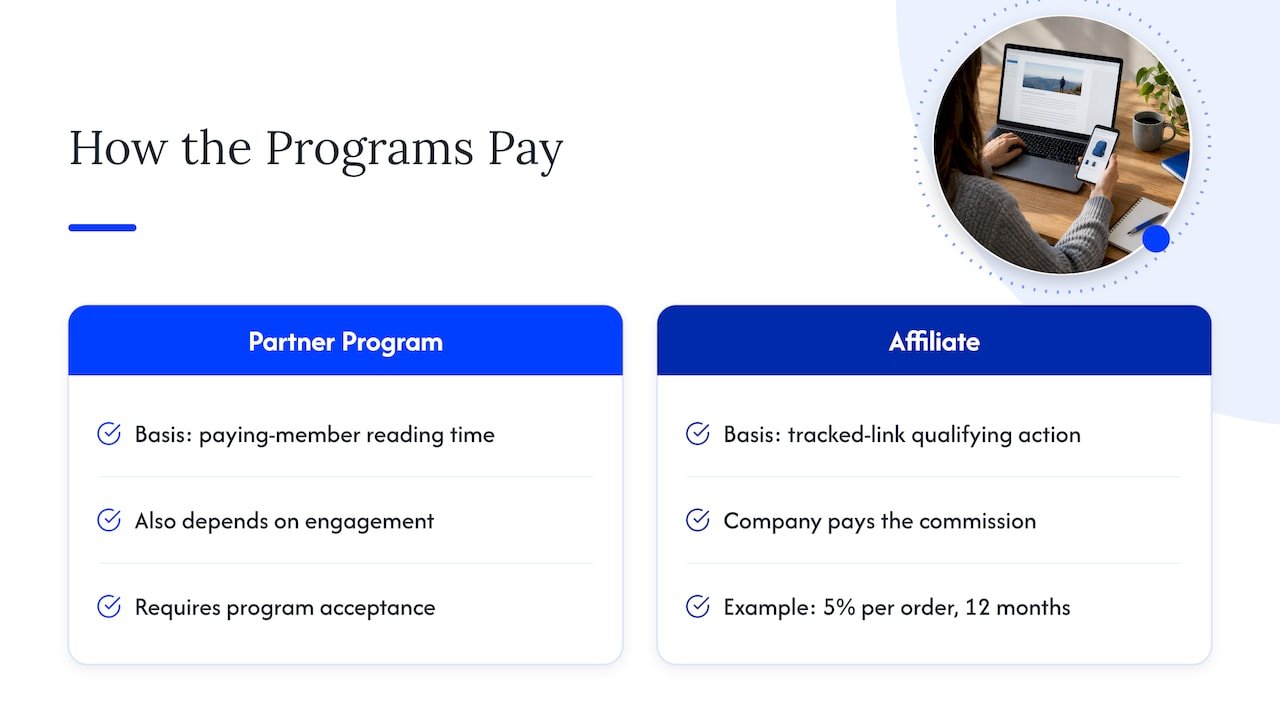
The Partner Program pays writers based on how long paying members read their stories. According to one 2026 explainer, earnings come from a share of members’ subscription money and depend on member reading time and engagement, with payouts processed through Stripe once you pass a minimum balance. You need to be accepted into the program, and the reader has to be a paying member for the read to count.
Affiliate commissions work the other way around. The company whose product you recommend pays you when a reader clicks your tracked link and completes a qualifying action. One Medium-focused guide gives a concrete example: a print-on-demand program that pays 5% of the product price on each referred order for 12 consecutive months, while noting that Partner Program pay is a separate matter based on member reading time. Always confirm current rates on the program’s own terms page, because commission structures change.
Why does this matter? Because the two incentives can pull in different directions. Partner Program earnings reward stories that keep members reading. Affiliate earnings reward stories that help someone decide to buy. The best affiliate stories on Medium manage both: they are good enough to keep people reading and specific enough to make a recommendation credible.
You can also use both at once. Many writers publish a story behind the paywall, include a disclosed affiliate link and earn from each. Just remember that a reader who hits the paywall and leaves never reaches your link, so consider which of your stories are better left open to everyone.
How to choose products that fit a Medium audience
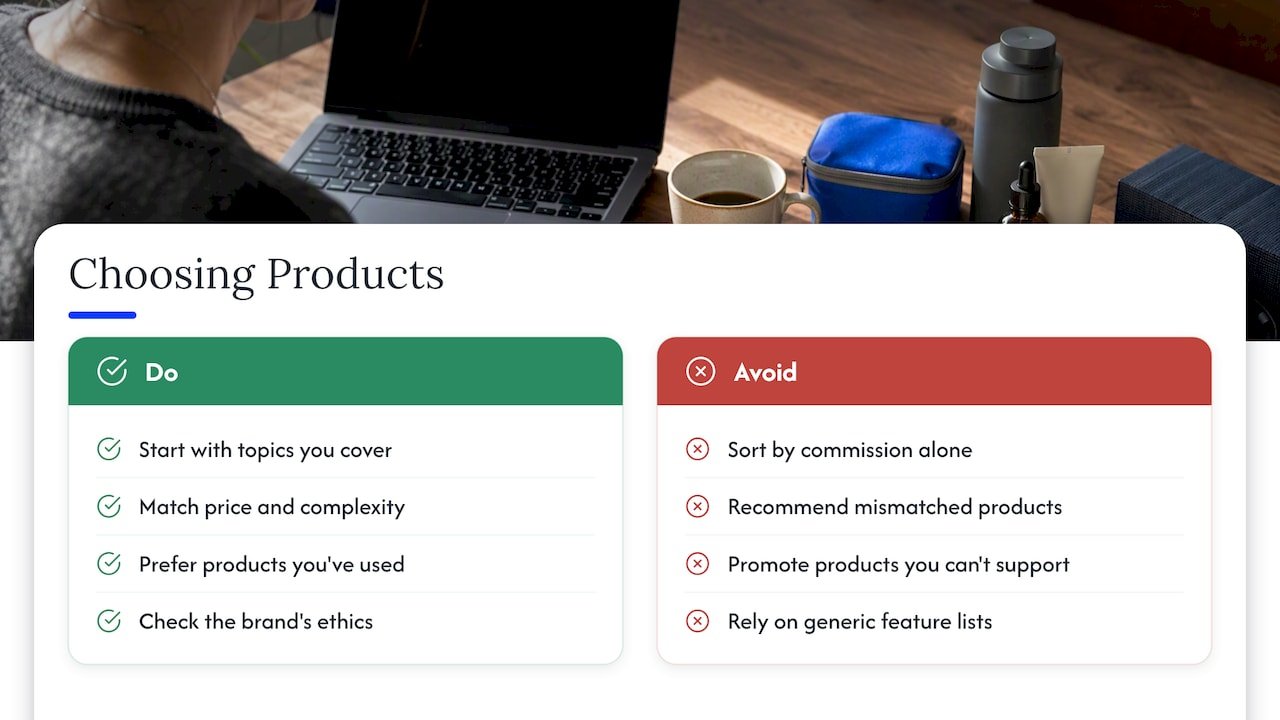
Most affiliate disappointments start here, not at the writing stage. The temptation is to scroll an affiliate network, sort by commission and pick the top result. A better approach starts with the reader.
Start with topics you already cover. A Medium guide on the subject suggests choosing programs relevant to the subjects you already write about, and checking whether the program’s terms allow promotion on Medium. A writer with a track record on productivity has no business suddenly recommending hosting plans.
Match price and complexity to your readers. The same guide advises matching the product’s price and complexity to what your audience can afford, and preferring products you have used or can support in good faith. A $400-a-month enterprise platform is a hard sell to a reader scrolling Medium on their phone; a $15 tool that solves a specific pain point is not.
Do not chase the highest commission. One affiliate-software company makes the point well: high commission rates mean little if the product does not solve a problem your reader actually has. If you need a way to think about this, this piece on audience-centric content covers choosing offers that address readers’ needs instead of prioritizing commission.
Test it first. A program-research guide from an affiliate platform says that trust is essential and that readers are less likely to click recommendations that feel untrustworthy. It also suggests considering the brand’s ethics and image before you tie your name to it. Specific, first-hand detail is what sells trust. A recommendation backed by your own screenshots, your own results and your own complaints is worth ten generic feature lists, and the same logic applies to anything about showing your face and your experience, as this guide to personal branding photography explains for building a credible personal brand.
If you want a more structured way to find topics where buyers, not just browsers, are searching, our five-step affiliate keyword research process works just as well for deciding what to write about on Medium.
How to write a Medium story that earns clicks
Medium readers are not looking for a sales page. They came for a story, an idea or a solution. So structure your post the way a good friend would explain something over coffee.
Open with your own problem
Guidance aimed at Medium writers recommends leading with a personal problem, a case study or an experience and delivering useful information before you present the product. Have you ever spent a weekend trying to fix something and finally found a tool that solved it in ten minutes? Start there. Tell the reader what was going wrong, what you tried and what finally worked.
Another Medium guide reports that authenticity matters most, with personal narratives about specific use cases outperforming generic feature lists. That fits what we see across every platform: the more specific your story, the less your recommendation sounds like an ad.
Give value before the offer
By the time the reader reaches your link, they should already have learned something they can use, even if they never click. That is what earns the click from the people who do need the product. A simple order works well:
- A real problem, told from your side.
- What you tried first and why it fell short.
- The practical steps or lesson, useful on their own.
- The product, with exactly how you used it.
- The honest drawbacks and who should skip it.
Notice step five. The same Medium-focused guidance recommends explaining drawbacks honestly. Readers can smell a story with no downsides, and a fair “this is not for you if…” line is often what convinces the right person.
Keep links few and relevant
The guidance cited above suggests using no more than three outbound affiliate links per story. Fewer is usually better. One clear recommendation, placed where the reader naturally wants it, beats a wall of blue text. Put the link at the moment of need, not in a block at the bottom.
If you use AI to speed up drafting, keep your own experience at the center. We cover that balance in why the evidence pack comes first for AI content, and in our look at how to humanize AI content so it still sounds like you.
Disclose your affiliate links properly
Medium requires disclosure, and in the United States the FTC does too. The FTC’s position, set out in a warning letter, is that a material connection between an endorser and the marketer should be clearly and conspicuously disclosed when it might affect how much weight or credibility readers give the endorsement, unless the connection is already obvious from context.
In practice, that means a line near the top of the story, before the first link, in plain words. Something like: “This story contains affiliate links. If you buy through them, I may earn a commission at no extra cost to you.” Do not bury it in a footer or a vague “thanks for supporting me.”
Also avoid relying on a platform’s built-in label alone. In another warning letter, the FTC cautioned that tools such as a “Paid Partnership” label may not be enough by themselves and advised clear disclosures within the content itself. Medium is a different platform, but the principle is the same: put it in your own words, inside the story.
Rules differ in other countries, so if you write for readers outside the US, check your local advertising regulator. For ready-to-use wording, see our affiliate disclosure examples, and for the bigger trust picture, our guide on EEAT for affiliate sites and FTC steps.
Track clicks, conversions and commissions
The platform gives you reading stats for each story, but it will not tell you which story produced a sale. That information comes from the affiliate program and from your own tagging.
A workable setup looks like this:
- Use a separate tracking link, sub ID or UTM tag for each Medium story, if the program supports it. Then your affiliate dashboard shows which story sent the click.
- Compare three numbers per story: views or reads on Medium, clicks in the affiliate dashboard and approved commissions.
- Review after a few weeks, not a few days. Many programs hold commissions as pending until the refund window passes.
- Keep a simple sheet listing story, offer, date published, clicks and commissions, so you can see patterns.
If clicks are low but reads are high, the story is interesting but the offer is poorly placed or poorly matched. If clicks are high but sales are low, the offer or the landing page may not fit what you promised. Our post on affiliate attribution models goes deeper on why last-click numbers can undersell a story that introduced the reader to the product in the first place.
What results to expect
Here is where we need to be honest. The pages that rank for this topic are full of income reports, and some are impressive. Treat them as one person’s story, not a forecast. Their results depend on things you cannot see from the headline: how many years they have been publishing, the size of their existing audience, their niche, and whether the money came mostly from Medium or from an email list and sites they own.
What tends to drive results on Medium:
- Niche and buyer intent. A story solving a specific, costly problem attracts people ready to act. A general inspirational post does not.
- Consistency. One story rarely changes anything. A library of useful stories compounds slowly.
- Product fit. A cheap, easy-to-understand product converts more easily than a complex one.
- Trust. Readers who have seen you be honest about drawbacks click more readily next time.
- Traffic beyond Medium. Stories that get found through search or your own audience do better than stories that depend only on the platform’s recommendations.
With a free Medium account you may earn nothing for months. That is normal, and it is not a sign you are failing. If you want a grounded look at what real numbers can look like, our affiliate marketing case study data shows how results actually build.
One more thing: do not build your whole business on rented land. A platform can change its distribution, its rules or its payouts. Add an email signup to your Medium profile and stories, and send the best readers to somewhere you own. Our notes on growing an AI newsletter for marketers cover how to do that without spending your whole week on it.
Our take on affiliate marketing on Medium
We like Medium for one reason: it rewards the thing that works in affiliate marketing anyway, which is honest, specific storytelling. You do not need a big site or a design budget. You need a real experience and the patience to write it well.
But we would not treat it as your only channel. Think of Medium as a place to test ideas. Write a story about one product you truly use, see how readers react, look at the clicks and then take what you learned to your own site, your email list or another channel. The stories that perform are usually the ones where you hesitated before publishing because you were being so frank about what worked and what did not.
And please go easy on yourself if you have been putting this off. Most of us have sat on a half-finished draft for weeks, waiting until it felt perfect. Procrastination is an insidious force, and the cure is usually a smaller first step: one story, one product, one clear disclosure. Publish it, learn from it, and improve the next.
We also lean on AI to save time on the repetitive parts, such as outlines, repurposing and tracking, while keeping the lived experience human. If that interests you, our guide to AI workflow automation for affiliate marketers is a good place to begin.
— Will
Get help building your AI-powered affiliate workflow
If you want to publish stories like these faster without losing your voice, we teach affiliate marketers how to use AI for research, drafting, repurposing and tracking. Start with our practical guide to the best AI writing tools for marketers and creators, then explore the rest of what we share at willbuckley.com.

You will find tips, tutorials and newsletters built for people who want smarter, less time-consuming ways to promote the programs they believe in.
FAQ
Does Medium allow affiliate links?
Yes. Affiliate links are allowed, provided you disclose in the post that it contains them. Other paid placements such as display ads are not permitted in your stories, so check Medium’s current help pages before you publish.
Does Medium pay writers?
Yes, through the Partner Program, which pays based on how long paying members read your stories. You have to be accepted, and payouts run through Stripe once you reach a minimum balance. It is separate from any affiliate commission you earn.
How many affiliate links should I put in one Medium story?
Medium-focused guidance suggests no more than three, and one or two well-placed links is often enough. Place each where the reader would naturally want the recommendation, after you have given them something useful.
Do I need a disclosure if my readers already know I am an affiliate?
Yes, put it in the story anyway. The FTC says a material connection should be clearly disclosed unless it is obvious from context, and a reader landing on a single story cannot be assumed to know your history.
Can I earn money from Medium without being in the Partner Program?
Yes. Affiliate links work regardless of Partner Program status, since the company you promote pays you, not Medium. Just confirm the affiliate program’s terms permit promotion on Medium.
Sources
- Affiliate marketing on Medium: using affiliate content
- Medium Partner Program: how writers get paid
- Affiliate marketing on Medium guide
- How to research affiliate programs
- How to find products for affiliate marketing content
- Affiliate marketing on Medium (2026 guide)
- FTC warning letter on material connections
- FTC warning letter on platform disclosure tools