

Yes, you can earn affiliate commissions on LinkedIn, but not the way you would on Pinterest or YouTube. There is no native affiliate link tool, paid ads for affiliate offers are off the table, and your audience will punish anything that smells like a pitch. What works is simple to say and harder to do: build a professional profile people trust, share genuinely useful advice about tools you use, and send interested readers to a page you own, where the affiliate link and the disclosure live.
If you have ever wondered whether LinkedIn is worth the effort, this guide walks you through why it can be, how to set it up, what to post, and how to stay on the right side of both LinkedIn and the FTC.
TL;DR
- LinkedIn works best for B2B and professional offers (software, services, courses) where a recommendation from a peer carries weight.
- Use your personal profile, not a company page, and send readers to your own landing page or newsletter rather than pasting raw affiliate links everywhere.
- Disclose the commission clearly, above the “see more” fold, in plain words like #ad or #affiliate link.
- Skip mass DMs and affiliate ads. Reply publicly first, and only message someone when you have a specific, useful recommendation.
- Expect a slower payoff: LinkedIn content is often the first touchpoint in a long buying cycle.
Table of Contents
- Why LinkedIn deserves a place in your affiliate plan
- What LinkedIn will and will not let you do
- Set up your profile to earn trust first
- Content that earns clicks without feeling like selling
- Direct messages: the high-risk, high-reward tool
- Disclosure: do it before the “see more”
- Our perspective: slow is the strategy
- A simple 30-day plan
- Mistakes that quietly cost you
- Where we can help
- FAQ
- Sources
Why LinkedIn deserves a place in your affiliate plan
Most affiliate conversations center on consumer platforms, so LinkedIn gets dismissed. That is understandable, but it also means less competition for the people who show up with real expertise.
The audience is the draw. One industry roundup reports 1.20 billion registered members as of January 2025, with 80% of members driving business decisions. Those are people who research vendors, compare tools and ask peers what they actually use. That is exactly the moment when a recommendation for a CRM, an email platform, an AI writing tool or a course converts.
The flip side is tolerance. According to marketers who work the platform, LinkedIn users have little patience for overtly promotional content, so the winning frame is peer advice. You are not selling. You are saying, “Here is what solved this problem for me, and here is where to look.” The affiliate link simply captures value from a referral that was genuine anyway.
Which offers fit, and which do not
Think about what a professional would be comfortable buying on a Tuesday afternoon between meetings. Software subscriptions, automation tools, analytics platforms, training programs and professional services fit. Impulse consumer products, anything with hype-heavy claims, and offers you have not personally tested do not.
A good test: would you recommend this to a colleague you respect, with your name attached? If you hesitate, skip it. Your reputation on LinkedIn is tied to your real name and your job history, so it is also the thing you can least afford to burn.
What LinkedIn will and will not let you do
Before you plan anything, know the boundaries.
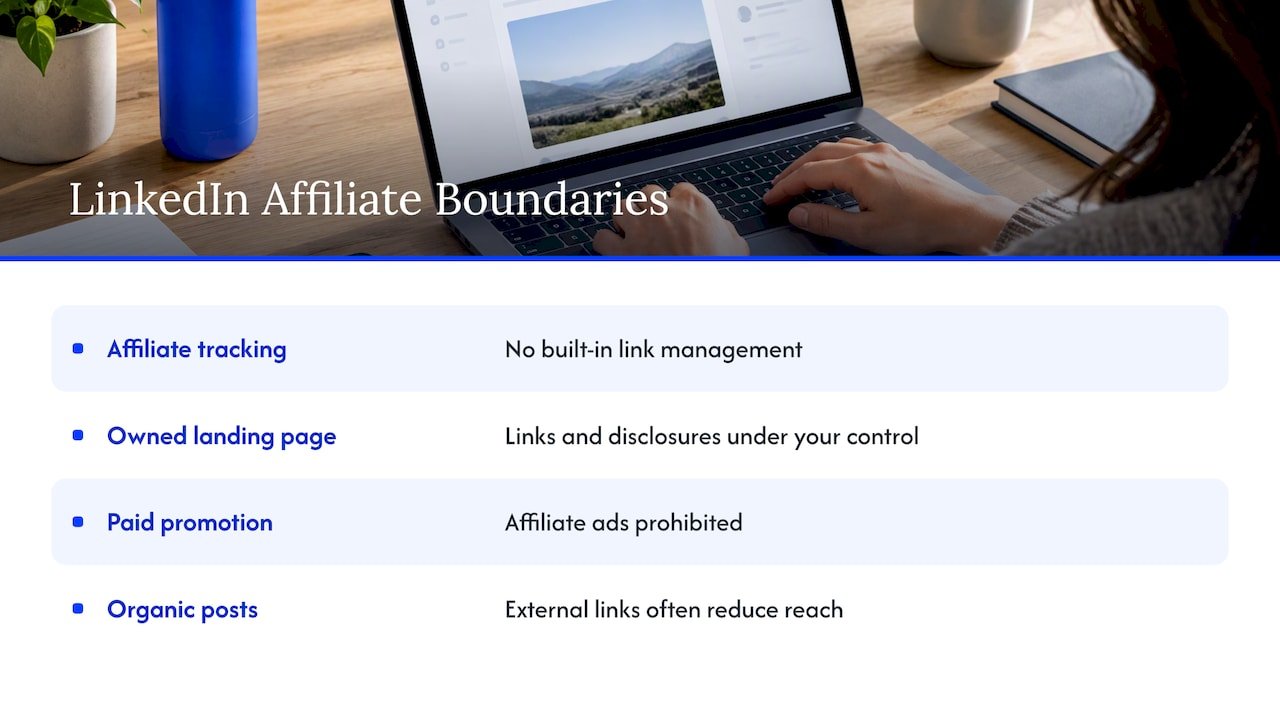
LinkedIn does not offer a built-in way to manage affiliate links, so you have to handle your own tracking. The strategy that holds up best is sending traffic from your posts to a landing page or newsletter you own, where the affiliate links and disclosures sit under your control. That keeps you compliant with platform terms and lets you shape what the reader sees.
Paid promotion is a different story. A 2026 summary of LinkedIn’s ad rules lists affiliate advertising among prohibited ad categories. So if you were planning to boost a post with a raw affiliate link, rethink it. Check LinkedIn’s current advertising policies directly before spending anything, because platform rules change.
Organic reach has its own quirks. Posts with an external link in the main text are often shown to fewer people, which is why experienced marketers put the link in the first comment or on a bridge page in the Featured section or About field. Treat that as common practice rather than a guarantee, and test it with your own audience.
Set up your profile to earn trust first
Your profile is your storefront, and it has to work for someone who has never heard of you.
Practitioners report that individual profiles can outperform company pages on engagement by something like 8x. That is an industry claim, not a promise, but the direction makes sense: people follow people. So build the personal brand and let it do the work.
Here is a simple setup you can finish in an afternoon. Write a headline that says who you help and how, not just your job title. Use the About section to explain your experience and the kinds of tools you review, and add one sentence saying you sometimes earn commissions on recommendations. Then put a single bridge page in your Featured section: a clean page listing the tools you recommend, why, and who each is best for.
That bridge page is your most important asset. It is where your affiliate links live, where your disclosure sits right next to them, and where you can measure what is happening. If you want to get the tracking right, our guide to a cookieless affiliate link tracking setup walks through it step by step, and the Google Tag Manager for affiliates tutorial shows how to capture clicks without guesswork.
One more point on the bridge page: it needs to look credible. A thin page full of links does not persuade a procurement-minded professional. If you are building from scratch, a site designed around lead generation for service-based professionals shows the kind of clear, conversion-minded structure worth borrowing.
Content that earns clicks without feeling like selling
LinkedIn rewards helpfulness. Here is how to make that practical.
Post from real experience
Share a short story about a problem you solved: how you cut your reporting time, what went wrong when you first set up a tool, what you would do differently. Name the tool in the story and keep the offer secondary. A post that teaches something can mention a tool; a post that only exists to mention a tool gets ignored.
A useful rhythm is three value posts for every one that points toward a recommendation. The value posts build the audience that makes the recommendation worth reading.
Use long-form articles and a newsletter
B2B buying is slow. Content often acts as the first touchpoint in a buying cycle that includes demos and several reviewers, so LinkedIn Articles and newsletters are a better fit than one-off impulse posts. Articles can pick up search traffic over time, and a newsletter gets you in front of the same people repeatedly. If you are weighing how to grow one, we broke down three levers that actually grow an AI newsletter for marketers.
Repurpose instead of starting from zero
You do not need to write everything fresh. A blog post can become a carousel, a short text post and a newsletter segment. Our roundup of AI content repurposing tools covers ways to do that without losing your voice, and if a draft starts to sound robotic, the humanize AI content workflow helps you fix it before anyone sees it.
Direct messages: the high-risk, high-reward tool
DMs can be powerful on LinkedIn, which is exactly why they get abused. Mass automated outreach or pasting affiliate links to strangers will likely lead to account restrictions, and the damage to your reputation can outlast the restriction.
The approach that holds up is slower. Wait for a connection to post about a problem. Reply publicly with a helpful insight. If the conversation continues and a specific tool would genuinely help, offer to send it in a DM, and say plainly that you may earn a commission. One person, one problem, one honest suggestion.
It feels like less volume because it is. But a handful of warm conversations per week will beat hundreds of cold messages that get you reported.
Disclosure: do it before the “see more”
This is the part many people get wrong, and it matters. If you earn a commission, that is a material connection, and under FTC guidelines it must be disclosed clearly and conspicuously. For social posts, the guidance is to place the disclosure above the “see more” cutoff, using unambiguous language such as #ad or #affiliate link, so no one has to click to find it.
The FTC’s Endorsement Guides are its formal statement of how it interprets deceptive advertising rules, most recently updated in June 2023. That summary is from a law firm, not the regulator, so for anything high-stakes, read the FTC’s own guidance or ask a qualified attorney about your specific situation.
These rules are US-specific. If you or your audience are elsewhere, check your own country’s advertising rules too.
In practice, that means three things. Put the disclosure in the first line or two of any post that includes or points to an affiliate link. Repeat it on the bridge page, right beside the links. And do not hide it in a block of hashtags. For ready-to-use wording, see our affiliate disclosure examples and the five FTC steps for affiliate sites.
Our perspective: slow is the strategy
We come at this as teachers first. After years of coaching and mentoring, the pattern we see is that affiliate marketers rarely fail from lack of tactics. They fail because they chase the quick click, get discouraged when it does not come, and quit before trust has had time to build.
LinkedIn punishes that impulse more than any other platform, and honestly, that is a gift. It forces you to do the thing that works everywhere: help people first, be honest about how you earn, and let your track record speak. If you are the kind of person who puts things off until you feel ready, start small. One useful post this week. One bridge page. One tool you genuinely use and can explain well.
We also lean on AI here, carefully. It is great for drafting outlines, summarizing what you learned from a tool test, and tidying up a bridge page. It is not a substitute for your experience. The readers on LinkedIn can tell when nobody is home, and the posts that perform are the ones with a real person’s story in them.
— Will
A simple 30-day plan
If you want to start without overthinking it, here is a gentle way to pace the first month.
In week one, update your headline and About section, choose three tools you have personally used, and draft your bridge page with a clear disclosure. In week two, publish two value posts with no links at all, and spend ten minutes a day leaving thoughtful comments on posts from people in your niche. In week three, share one story post about a tool, with your disclosure in the first line and the link in the first comment or on your bridge page. In week four, look at what happened: which posts got comments, which clicks came through, and which questions people asked. Then write your next posts to answer those questions.
Track from day one. Without it you cannot tell whether a post that got many likes actually sent anyone to your page. Our guide to affiliate attribution models explains how to credit the touchpoints that matter, which is especially helpful on a platform where readers often see you several times before clicking.
Mistakes that quietly cost you
The most common one is promoting too early. An empty profile with a link in the first post tells people exactly what you are after. A close second is recommending tools you have not used, which falls apart the first time someone asks a follow-up question.
Others: leaving the disclosure below the fold, running everything through one bloated bridge page with 40 links, and judging results after a week. B2B cycles are longer than that. Give any approach at least a couple of months of consistent posting before you decide it does not work.
Finally, do not forget the numbers around your own site. If your landing page is slow or your links break, you lose the very readers LinkedIn worked to send you. Running an AI link placement audit on your key pages is a quick way to catch that.
Where we can help
If you want to go further than one platform, we publish practical, AI-assisted workflows for affiliate marketers, from content and tracking to newsletters. A good place to start is our AI workflow automation for affiliate marketers guide, which shows how to save hours each week on the repetitive parts. You can also browse everything on willbuckley.com.
If you are exploring other channels beside LinkedIn, our guides to Pinterest affiliate marketing and Quora affiliate marketing follow the same honest, step-by-step approach.
One more idea for later: once your audience trusts you, you may want a stronger SEO base for the pages you send them to. A resource on backlink diversity for SaaS SEO is a useful read when you reach that stage, especially if you promote software.
FAQ
Can you put affiliate links directly on LinkedIn?
You can, but it is rarely the best move. LinkedIn has no native affiliate tool, and posts with external links in the main text are often shown to fewer people. Most marketers send readers to a bridge page or newsletter they own, or place the link in the first comment, and always disclose the commission.
Can I run LinkedIn ads for affiliate offers?
Not directly. A 2026 summary of LinkedIn’s advertising policies lists affiliate advertising as prohibited. Read LinkedIn’s current ad policies before you spend, since rules can change and rejected campaigns waste budget.
How do I disclose affiliate links on LinkedIn?
Put a clear statement in the first lines of your post, above the “see more” cutoff, using plain terms like #ad or #affiliate link. Repeat the disclosure beside the links on your bridge page. These are US FTC expectations, so check local rules if you are outside the US.
Is LinkedIn better than other platforms for affiliate marketing?
It depends on what you promote. For B2B software, services and training, LinkedIn puts you in front of decision makers. For consumer products, visual or short-form platforms usually fit better. Expect LinkedIn to pay off more slowly, because content is often the first step in a long buying process.
Sources
- LinkedIn Advertising Statistics 2025, SEO Design Chicago
- Affiliate Marketing on LinkedIn, Vivian Agency
- How to Do Affiliate Marketing on LinkedIn, Affground
- LinkedIn Ad Policies 2026, Audit Socials
- How US influencers keep their content compliant with the FTC, LTK
- FTC Disclosure Rules for Influencers and Brands, HCH Lawyers