

You can make AI write in your brand voice, but not with a one-click setting. You get there by writing down how you sound, giving the model real examples of your best work, and reviewing what comes back like an editor would. Do those three things and your drafts stop sounding like everyone else’s.
Have you ever pasted a prompt into an AI tool, read the result, and thought, “That’s fine, but it’s not me”? You’re in good company. This guide walks you through why that happens and a simple process to fix it, written for affiliate marketers and solo creators who don’t have a brand team.
TL;DR
- AI sounds generic when it has nothing specific to copy. Feed it a short voice guide and real samples of your best writing.
- Describe your voice with concrete rules and before-and-after examples, not adjectives like “friendly” or “bold.”
- Treat AI like a talented intern: it drafts, you edit. Most organizations still check AI output by hand.
- Save the guide inside your tool of choice so every session starts on-brand.
- Review a small batch every month and update the guide when drift shows up.
Table of Contents
- Why AI Sounds Like Everyone Else
- What the Research Says About Voice and AI
- Start With a Voice Guide That a Machine Can Follow
- Ground the Model in Your Best Writing
- Turn the Guide Into Prompts and Rules
- Review Like an Editor, Not a Proofreader
- Keep Your Voice Consistent Across Channels
- What Brand Voice Tools Cost
- Our Perspective: Your Voice Is the Asset, Not the Tool
- Want Help Putting This Into Practice?
- A Simple Voice Setup You Can Finish This Week
- FAQ
- Sources
Why AI Sounds Like Everyone Else
Large language models learn from an enormous amount of text, so their default is the average of it. Ask for a friendly blog intro and you get the friendliest, most average intro possible. That is the opposite of a voice.
Your voice is the pattern that makes readers recognize you in a crowded feed: the words you reach for, how long your sentences run, the jokes you make, the things you never say. A model can imitate that pattern, but only if you show it the pattern.
The stakes are real. In a late-2025 survey, 92% of organizations reported using more AI content than the year before, and 41% of leaders named brand misalignment or tone inconsistency as a top risk. The same report found only 33% see their AI guardrails as strong and consistently applied. Scaling output without a voice standard is how a brand slowly turns beige.
If you are a one-person operation, that risk is even more personal. Your voice is often the main reason people trust your recommendations in the first place.
What the Research Says About Voice and AI
It helps to know what AI is good at and where people still win, so you can split the work sensibly.
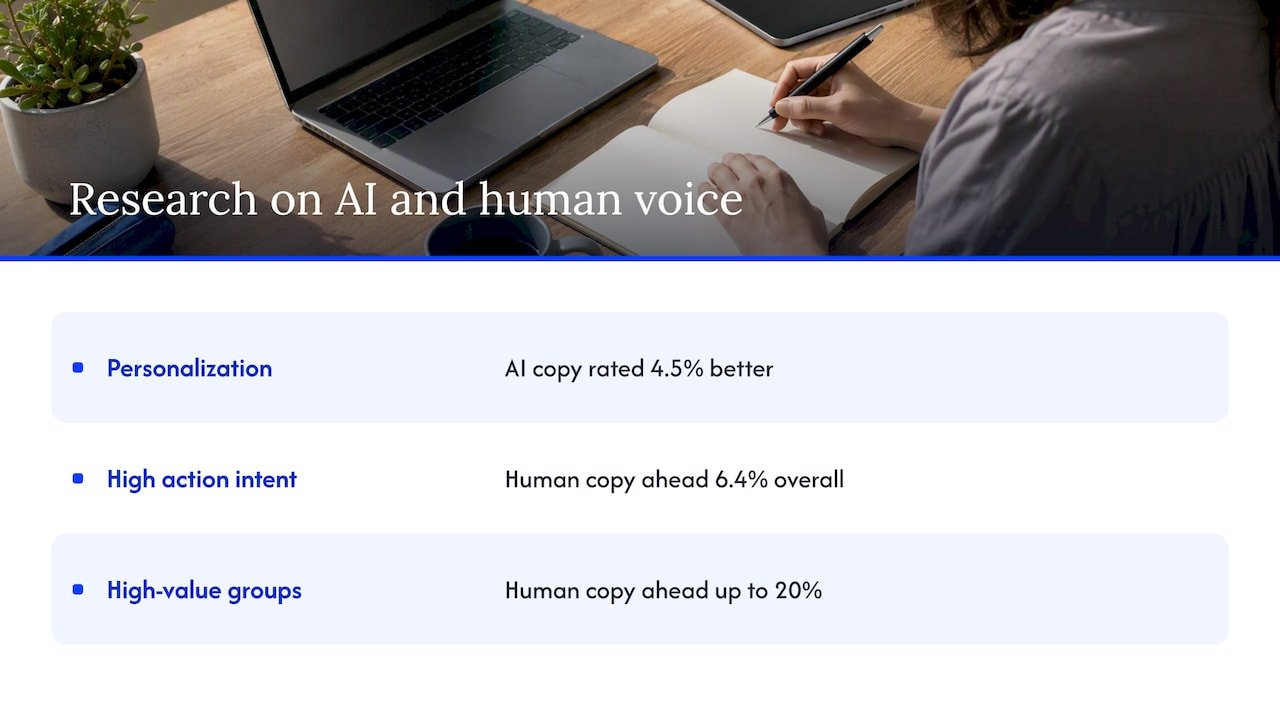
Deloitte Digital tested AI-written and human-written marketing copy. GenAI content was rated 4.5% better on average for personalization, yet human-written content came out ahead when consumers were highly willing to act, by 6.4% overall and by as much as 20% in some high-value groups. In other words, AI is a strong drafter, but the final push toward a decision still benefits from a human touch.
A 2025 framework paper on brand voice describes the healthiest setup as co-creation: people keep the contextual and emotional judgment, and AI handles scale and data-heavy personalization. That fits what we see in practice. You decide what you mean. The model helps you say it faster.
One more finding is worth keeping in mind if you ever use synthetic audio. A Finnish study on consumer reactions found that recognizable AI voices tend to trigger more critical processing and can provoke negative feelings, while unrecognized ones are processed more naturally. The lesson for written voice is similar: the goal is not to show off the machine, it is to sound like a real person you already trust.
Start With a Voice Guide That a Machine Can Follow
A brand voice guide for AI is not a glossy PDF. It is a short, plain document you can paste into a chat or store as standing instructions. Aim for one to two pages.
Begin with who you are writing for and what you want them to feel. A line like “We write for new affiliate marketers who feel behind and want a calm, practical next step” tells the model more than a list of adjectives ever will.
Then describe how you sound in observable terms. How long are your sentences? Do you ask the reader questions? Do you use contractions? Do you speak as “I” or “we”? Do you use humor, and what kind? Name the habits, because a model can follow habits and it cannot follow vibes.
Next, write your never-list. Maybe you avoid hype words like “game-changer,” you skip income promises, and you never open with a throat-clearing line about how fast the world is moving. A short list of banned phrases does more to kill generic copy than almost anything else you can add.
Finally, include contrast pairs. Show one sentence the way a generic AI would write it and the same idea the way you would say it. Two or three of these pairs teach tone better than a page of description.
A quick example of a contrast pair
Generic AI might write: “Leverage cutting-edge automation to unlock unprecedented efficiency in your affiliate workflow.” A warm, practical voice says: “Pick one boring task you repeat every week and let a tool handle it. You’ll get that hour back.” Same idea, but only one of them sounds like a person you’d want to learn from.
Ground the Model in Your Best Writing
Practitioners in the research describe a difference between amateur prompting and expert work: grounding, which means anchoring the AI to curated material such as brand manuals, past winning copy and core values. A thesis on generative AI in digital advertising explores the same idea of grounding generated content in the brand’s own material.
For you, grounding is simple. Pick five to ten pieces you are proud of: emails that got replies, posts that readers shared, a video script that felt like you. Paste a few of them in as samples and tell the model what to notice. “Study how these open with a question, use short paragraphs, and end with one clear action.”
Choose samples that represent the voice you want, not just the voice you have used. If your old writing was stiff, don’t feed it in. Curate on purpose, because the model will treat everything you give it as the standard.
Keep a mix of formats if you work across channels. A newsletter, a social caption and a product review all carry the same voice at different volumes. Label each sample so the model knows which context it belongs to.
Turn the Guide Into Prompts and Rules
Your guide only helps if it is present every time you write. There are a few ways to make that happen, depending on the tool you use.
Most chat assistants let you save standing instructions or keep a project with reference files. Paste your guide there once, and each new conversation starts with your voice already loaded. If your tool lacks that feature, keep the guide in a note and paste it at the start of each session.
Then write the task prompt on top of it. Tell the model the audience, the goal, the format and the length, and ask it to follow the guide. If you want a deeper walkthrough on structuring requests, our guide on prompt engineering workflows for affiliates covers it step by step, and a prompt library keeps your best versions in one place so you stop rewriting them.
Brands that treat this as a system rather than a stack of clever prompts tend to do better. One agency makes the case for rules over prompts in generative AI branding, which matches our view: write the standard once, then let every prompt inherit it.
Briefs matter too. A vague request produces a vague draft in any voice. Our AI brief templates give the model the audience, angle and proof it needs before it writes a word.
Review Like an Editor, Not a Proofreader
Here is where many people slip. The draft looks clean, so they publish it. But clean is not the same as yours.
There is a funny gap in the Markup AI survey: 97% of organizations believe AI models can check themselves, yet 80% still rely on manual or spot checks. People say they trust the tools and still check them, and they are right to. Think of the model as a capable intern. It works fast, it needs direction, and it should never sign off on its own work.
When you review, read for voice first and facts second. Ask yourself whether you would say this out loud, whether any sentence sounds like a brochure, and whether the opening earns the next line. Then fix the model’s habits at the source. If it keeps writing “dive into,” add that phrase to the never-list.
A lightweight loop works well. Generate, edit, and note what you changed. After a few pieces, patterns show up. Those patterns are your next guide update, and they make the next draft better.
If the draft is close but still has that machine sheen, a final pass helps. Our walkthrough on how to humanize AI content shows a quick workflow for that last polish.
Keep Your Voice Consistent Across Channels
Consistency does not mean saying the same thing everywhere. It means sounding like the same person whether you are writing a LinkedIn post, a video script or a welcome email.
Write a short channel note in your guide for each place you publish. On LinkedIn you might be a little more reflective. In email you might be more personal and direct. In short video you might be punchier. The core habits stay put while the volume shifts.
A systematic literature review on AI content and brand identity on social media points to consistency as a driver of recognition, trust and engagement, which is the reason to bother with all this in the first place. If you repurpose one idea into many formats, the voice guide is what keeps the pieces feeling related. Our roundup of AI content repurposing tools shows how to stretch one piece without flattening it.
If you want a view of how your brand actually shows up once it is out in the world, it also helps to look at mentions and share of voice. This piece on measuring brand awareness with AI analytics is a good place to start.
What Brand Voice Tools Cost
You do not need a paid platform to begin. A saved set of instructions, a voice guide and a handful of samples inside the assistant you already use gets you most of the way.
Dedicated tools exist if you need them. According to one 2026 comparison, entry-level tools for tracking AI share of voice start around $29 a month, while platforms with deeper engine coverage run from $60 to more than $399 a month, and enterprise setups use custom pricing. Note that this is visibility and conversational AI pricing, so it is a rough guide to the range, not a quote for any single voice feature.
My advice for most solo marketers: start free, prove the process works, and only pay when a specific bottleneck, like volume or team handoffs, justifies it. If you do shop, compare options in our guide to the best AI writing tools before you commit.
Our Perspective: Your Voice Is the Asset, Not the Tool
We come to this from years of teaching and coaching, and the pattern is always the same. People don’t struggle because they lack a tool. They struggle because they haven’t decided who they sound like, and then they expect software to decide for them.
That is why we think of AI as a very fast assistant that learns on the job. It can draft, reshape and repurpose, but it can’t know what you have lived through, who you are trying to help or which promise you refuse to make. Those come from you, and in affiliate marketing they are the reason someone trusts your recommendation over a stranger’s.
So we suggest a calm, repeatable routine instead of chasing the perfect prompt. Write the guide in an afternoon. Ground the model in your best work. Edit every draft until it sounds like you, and update the guide as you learn. It is less glamorous than a magic button, but it saves real time and it protects the thing readers came for.
If you feel behind, that’s okay. Most people haven’t written their voice down yet, and starting this week puts you ahead.
— Will
Want Help Putting This Into Practice?
If you’d like to see these ideas applied to real affiliate work, start with our AI content strategy rollout, a 90-day plan for bringing AI into your content without losing your voice. You can also browse everything else we share for affiliate marketers on willbuckley.com, including coaching, tutorials and the newsletter.
A Simple Voice Setup You Can Finish This Week
If you like to see the whole thing laid out, here is a plan that fits into a few short sessions.
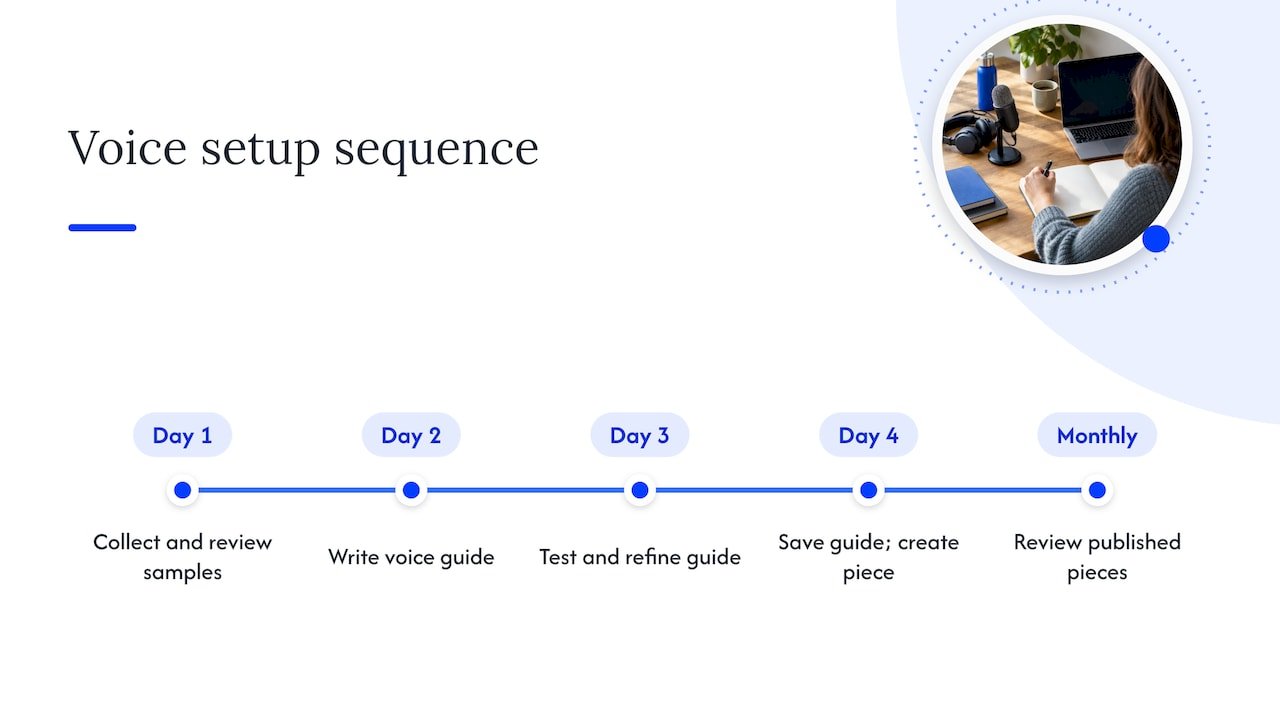
On day one, collect your samples. Gather five to ten of your best pieces and read them back to back. Highlight the sentences that sound most like you, and note what they have in common.
On day two, write the guide. Cover your audience, your habits, your never-list and two or three contrast pairs. Keep it under two pages, and make every line something you could check a draft against.
On day three, test it. Ask the model for the same short piece with and without the guide, and compare. The gap shows you what the guide is doing. Edit the guide wherever the output still drifts.
On day four, save it where you work, whether that is standing instructions, a project or a pinned note, and write your first real piece. After that, schedule a ten-minute review at the end of each month to read a few published pieces and ask whether they still sound like you.
If you publish affiliate content, remember that voice sits next to trust signals. Clear disclosures and real experience matter, which is why we pair this kind of setup with our guide to EEAT for affiliate sites.
FAQ
Can AI really learn my brand voice?
It can imitate a voice well when you give it clear rules and strong examples. It does not learn the way a person does, so you need to supply the guide and samples each time, usually by saving them as standing instructions. Expect to edit the output, especially early on.
How do I keep AI content consistent across channels?
Use one core voice guide and add a short note for each channel about how the volume changes. Review a small batch of published pieces each month and update the guide when you spot drift. Keeping the guide in one saved place helps every draft start from the same standard.
Do I need a paid brand voice tool?
Not to begin. A saved guide and a few samples inside the assistant you already use handle most solo workflows. Paid platforms make more sense when you have a team, high volume or a specific bottleneck you can name.
Will readers know my content was written with AI?
Sometimes they can, especially when the writing is generic. Research on AI-generated voice found that recognizable synthetic voices can trigger skepticism. The best protection is a specific voice, real experience and honest editing, and where rules or platforms require it, clear disclosure.
Sources
- Human-AI marketing collaboration, Deloitte Digital
- The AI Trust Gap: Why Every Enterprise Needs Content Guardrails, Markup AI
- Welcome, new brand colleague! A conceptual framework for human–AI co-creation for creative brand voice
- Voice of the future? Examining consumer responses to AI-generated voice in brand communication
- Situated Artificial Intelligence for Brand Identity Creation
- The Effect of AI-Generated Content on Brand Identity Consistency in Social Media
- Best Conversational AI Platforms in 2026: 8 Tools Compared