

You can use AI to write meta descriptions in minutes, but only if you give it the page itself, not just a topic, and then edit the result like a human who knows the reader. Skip those two steps and you get smooth, generic lines that could sit on any page of any site. Do both and you get a fast first draft you can sharpen into something people actually click.
If you run an affiliate site with dozens of reviews and guides, this matters. Each page is a small shop window in the search results, and the meta description is the sign in that window. Let’s build a simple routine for it.
TL;DR
- A meta description is a short page summary that can appear under your title in search results. It can earn clicks, but it does not influence rankings.
- Feed the AI the full page content, the audience and the language, then ask for several options instead of one.
- Google often writes its own snippet from page text, so a description that is accurate and specific to the page is the one most likely to be used.
- Check every draft against the page for unsupported claims, then measure clicks and click-through rate in Search Console.
Table of Contents
- What a meta description does (and what it doesn’t)
- Where AI genuinely helps with meta descriptions
- Feed the page, not the topic
- Meta description examples for different page types
- How to edit an AI draft before you publish it
- Mistakes to avoid when writing meta descriptions with AI
- Our perspective: speed is the gift, voice is the work
- How to tell whether your descriptions are working
- A simple weekly routine for affiliate sites
- Want help building your own AI workflow?
- FAQ
- Sources
What a meta description does (and what it doesn’t)
A meta description summarizes a webpage and appears after its title in search results. According to the UK Office for National Statistics content guidance, it can encourage people to click, but it does not influence rankings. That one sentence clears up a lot of confusion. You are not writing for an algorithm here. You are writing a short pitch for a person who is scanning ten blue links and deciding where to spend the next minute.
Google is just as clear that it decides what to show. Its documentation says it primarily builds snippets automatically from page content and sometimes uses your meta description when that gives searchers a more accurate picture of the page. In other words, your description is a candidate, not a guarantee. The way to become the chosen candidate is to describe the page better than the page’s own text does in a quick scan.
What about length? Google’s Search Central guidance says there is no fixed maximum length and that the displayed snippet is truncated to fit the device width. For practical editing, the ONS guidance suggests staying under 160 characters, ideally 90 to 120, because mobile may cut off longer text. Treat that as an editing habit, not a rule that Google enforces.
Where AI genuinely helps with meta descriptions
Have you ever opened a spreadsheet of 80 posts, realized half have no description, and quietly closed the tab? That is where AI earns its place. Summarizing a page you supply, within a few mechanical constraints, is something these tools do well.
It is already built into common workflows. The Yoast plugin, for example, has an AI feature that drafts a meta description from your page content, SEO title and focus keyphrase, and you can edit it before publishing. Chat assistants do the same job when you paste the page in yourself.
Where AI struggles is judgment. It does not know which detail of your review is the one readers care about, it cannot tell that your tone is friendly and a little cheeky, and it will happily promise “the ultimate guide” for a 600-word post. That is why the best approach is a split. One strategic recommendation from the eesel team is to write meta descriptions by hand for your high-traffic money pages and use AI for long-tail pages where volume makes hand-writing unrealistic. We agree with that, and we would add that even on long-tail pages the AI draft is a starting point.
Feed the page, not the topic
This is the single biggest difference between a useful draft and a forgettable one. If you type “write a meta description about email marketing tools,” the tool has only a topic, so it produces the average of everything it has seen. If you paste the full article, it can pull the real angle, the real numbers and the real recommendation.
The guidance from NitroSERP lines up with this: give the AI the actual page content, the main topic or target keyword, and the intended audience, then request several variations. If you want more depth on prompting AI tools to write accurate, page-specific descriptions, this walkthrough on prompting AI for meta descriptions is a good companion.
A prompt you can copy
Here is a prompt structure we like, built from the elements above. Paste your page text under it.
“You are an SEO editor. Below is the full text of a web page. Write five different meta descriptions for it. Audience: beginner affiliate marketers in the US. Language: American English. Use only facts that appear in the page text. Keep each under 150 characters. Use active voice and include the main keyword once, naturally. End with a reason to click, not a generic phrase. Do not start with ‘Discover,’ ‘Unlock’ or ‘Dive into.’ Do not promise results the page does not show.”
Three things in that prompt do the heavy lifting. “Use only facts that appear in the page” cuts down invented claims. The banned openers force less predictable wording. And asking for five options gives you something to choose between, which Search Engine Land also recommends: supply the real page content, ask for three to five variations, and rewrite the best one in your own voice rather than publishing the first output unchanged.
Add the details a searcher cares about
Google notes that a good description can include relevant details that are actually on the page, such as an article’s author or publication date, or a product’s price, age or manufacturer. For a review page, that might mean telling the AI to mention the pricing model or who the tool is best for, as long as the page states it. If it is not on the page, it does not belong in the description.
Be specific about language and market
If you run a site for readers in more than one country, tell the AI which one. Guidance on multilingual prompting stresses that you should specify the target locale, such as PT-PT or FR, so tone and phrasing fit the market instead of reading like a literal translation. Our guide to multilingual SEO with AI goes deeper on that.
Meta description examples for different page types
Search Engine Land points out that descriptions should match search intent: an informational query wants a learning-oriented summary, while a commercial query needs to show comparison, evaluation or purchase value. That is a useful lens for AI prompts, because you can tell the tool which type of page it is summarizing. The ONS guidance adds the basics: active voice, the primary keyword used naturally, and a clear call to action.
The examples below are ones we wrote to show the pattern. They are illustrations for fictional pages, so swap in your own facts.
| Page type | Weak, generic draft | Stronger, page-specific version |
|---|---|---|
| Tool review | Read our review of the best email tool and learn everything you need to know. | We tested the free plan for 30 days. See what it handles, where it limits you, and who should upgrade. |
| How-to guide | Learn how to start affiliate marketing with this complete guide. | Pick a niche, join your first program and publish three posts in your first week. A beginner path in six steps. |
| Comparison | Compare the top tools and find the best one for you. | Tool A vs. Tool B on price, templates and reporting, with a clear pick for solo creators. |
| Case study | See amazing results from our affiliate campaign. | One review post, 12 weeks, real traffic and commission numbers. Here is what moved and what did not. |
| Product roundup | Check out our list of top products for this year. | Seven standing desks under $400, ranked by stability, with the one we would buy again. |
Notice what changed. The stronger versions name a specific thing the reader will get: a trial length, a step count, a price ceiling. They also avoid hype words. If your page does not contain a number like that, do not let the AI invent one.
If you want to see how we structure the pages these descriptions sit on, our real affiliate marketing case study data shows the kind of concrete detail that makes a description easy to write honestly.
How to edit an AI draft before you publish it
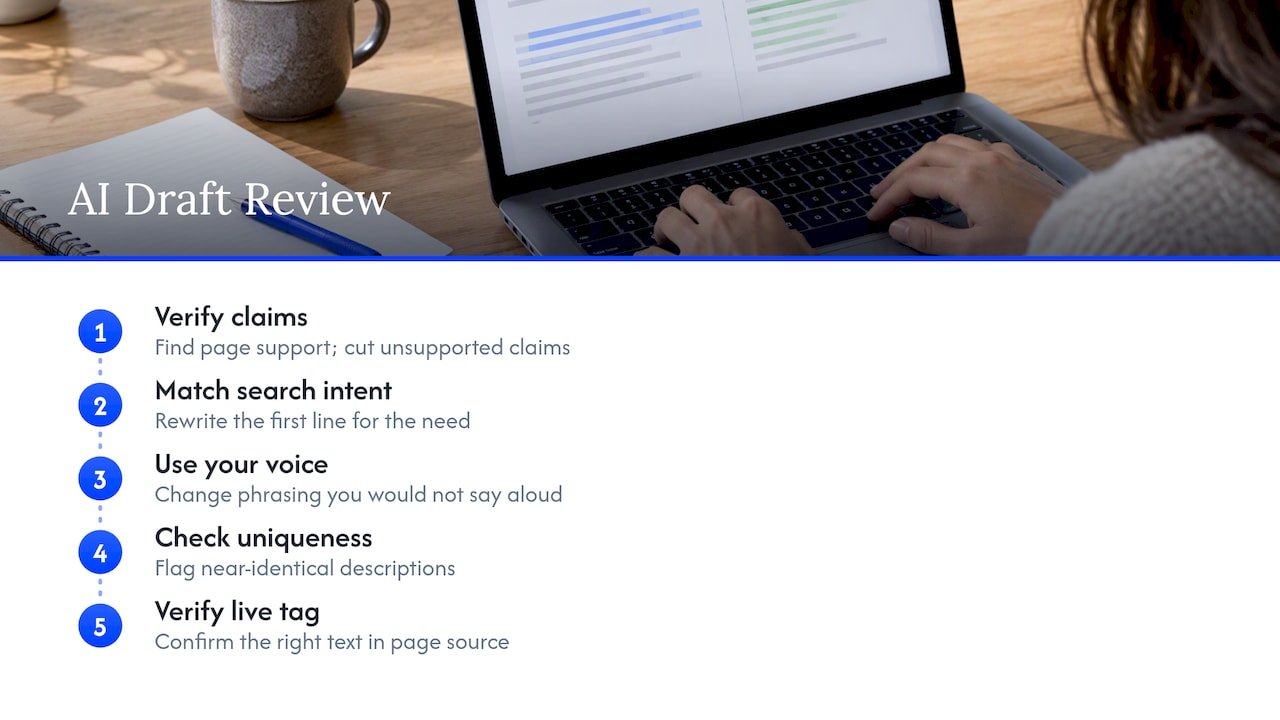
The draft is only half the job. Here is the routine we follow, in the order we follow it.
First, compare the draft with the page. Google’s guidance says descriptions should be accurate, specific to the page and readable by a human, not strings of keywords. Read each claim in the draft and find the sentence on the page that supports it. If you cannot find one, cut the claim.
Second, check the intent. Ask what the searcher typed and whether the description answers it. A reader looking for “how to write a meta description” wants to learn something. A reader looking for “best meta description tools” wants help choosing. Rewrite the first line so it speaks to that need.
Third, put it in your voice. AI tends to land on the same safe, upbeat phrasing, which is exactly why a plain, human sentence stands out. If you would not say it out loud to a friend, change it. We cover this in more depth in our piece on humanizing AI content.
Fourth, make sure the description is unique. If two of your pages end up with near-identical descriptions, that is a red flag we will come back to below.
Fifth, if you publish in bulk through a plugin or a script, open the live page source afterward and confirm the right tag appears with the right text. Bulk tools can fail quietly, and a description you never see is a description you cannot trust.
Mistakes to avoid when writing meta descriptions with AI
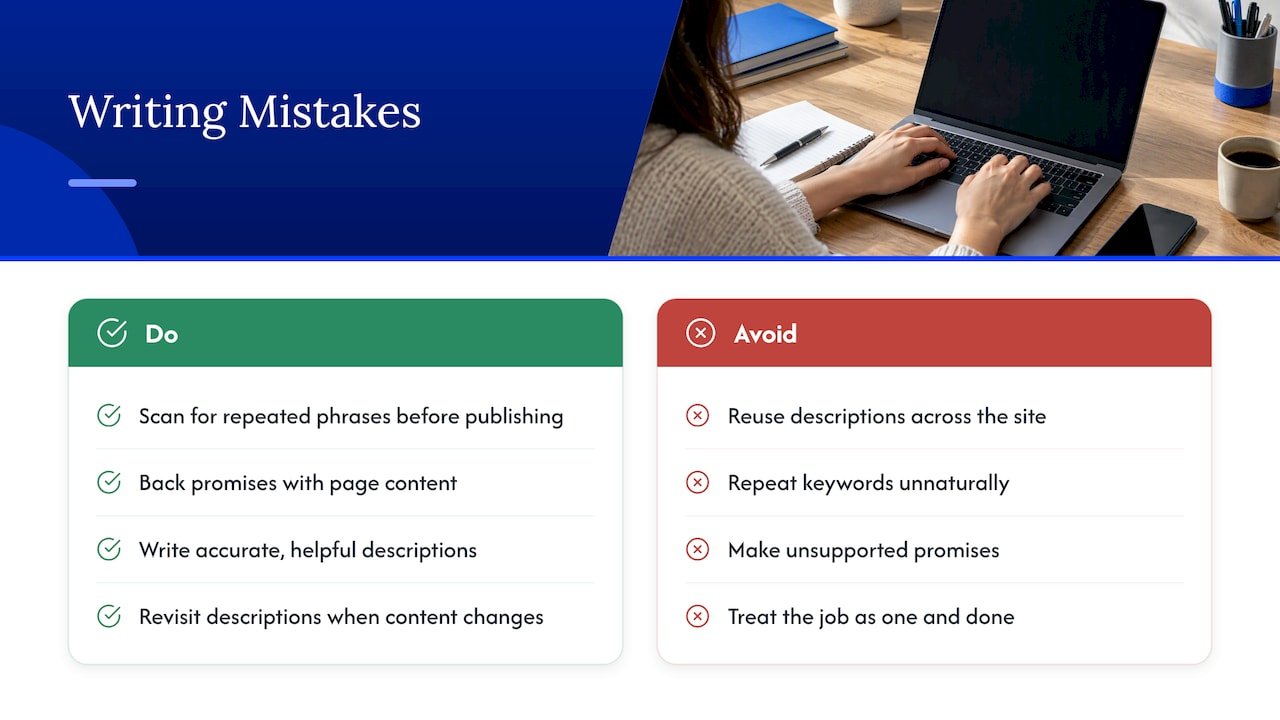
The most common mistake is duplication. Google recommends unique, page-specific descriptions and warns against using the same one across a site. When you run a batch through AI with a lazy prompt, near-copies are easy to produce. Scan your set for repeated phrases before publishing.
The second mistake is stuffing keywords. A line that repeats “best AI meta description generator” three times reads like a robot wrote it, and Google may simply ignore it and pull text from the page instead.
The third is the unsupported promise. AI will write “boost your traffic fast” without blinking. If the page cannot back that up, you are setting up a bounce and weakening trust. This matters doubly in affiliate content, where honest framing is part of how readers decide whether to believe your recommendations. Our guide to EEAT for affiliate sites covers how we approach trust more broadly.
The fourth is worrying about AI use itself. Google’s guidance says that using automation, including AI, with the primary purpose of manipulating search rankings violates its spam policies, and it frames the issue as the purpose and the resulting content, not the tool. A short, accurate, helpful description written with AI assistance is a different thing from mass-produced filler. If you want the fuller picture, read our steps to avoid a Google AI content demotion.
The fifth is treating the job as one and done. When you update a page, its description may no longer match. Revisit it whenever the content changes.
Our perspective: speed is the gift, voice is the work
We teach affiliate marketers to use AI as a tireless assistant, not a replacement for judgment. Meta descriptions are a perfect example. The assistant can read a 2,000-word post and hand you five summaries in the time it takes to refill your coffee. That saves real hours, and for a solo creator, hours are the scarcest thing you own.
But the part that earns the click is the part only you can supply: knowing your reader, knowing what you actually tested, and being willing to say something plain and true. We would rather see a modest description that tells the reader exactly what they will find than a shiny one that overpromises. Over time, readers learn whether your snippets keep their word, and that reputation is worth more than any single click.
So our rule is simple. Let AI do the first draft, let your own experience do the second, and never publish a claim you cannot point to on the page. If you are building out the wider process around this, our notes on prompt engineering workflows for affiliates show how to turn a good prompt into a repeatable habit.
— Will
How to tell whether your descriptions are working
Writing a description is a guess until you look at the numbers. Google Search Console is where you do that. Open the performance report, filter to a page, and look at impressions, clicks, click-through rate and average position. Impressions tell you how often the page appeared, and click-through rate tells you how often people chose it.
To judge a change fairly, compare similar periods before and after you edit, and write down anything else you changed in that window, such as a new title, a refreshed post or a seasonal swing. If your average position moved a lot, a click-through shift may have nothing to do with your description. Where you can, leave a few similar pages untouched as a comparison group. That makes it easier to tell whether your edit mattered or the whole site simply had a good month.
Give changes time. A few days of data on a low-traffic page is noise. For small sites like most affiliate projects, wait several weeks, change one thing at a time, and prioritize the pages with the most impressions, since those have the most to gain.
It is also worth knowing Google has added reporting beyond classic search. As of August 31, 2026, Search Console includes dedicated reports for site visibility in generative AI features on Search and Discover. That helps you see more of the picture, though it does not change the basics here.
One honest caveat on AI search. Coverage of AI answer engines suggests they generally read your actual content rather than leaning on the meta description when deciding what to cite. So do not expect a description to carry your visibility there. Strong, clear page content does that work, and we lay out the practical moves in our GEO playbook for ranking in AI answers.
A simple weekly routine for affiliate sites
If you manage a growing library of posts, a light routine beats a big cleanup that never happens. Pick one session a week. Start with the pages that get impressions but few clicks, since a better description is most likely to help there. Paste each page into your AI tool with the prompt above, pick the strongest of five options, edit it against the page, and publish. Note the date in a simple sheet next to the page URL so you can compare results later.
Once a month, check for pages with missing or duplicated descriptions, and revisit any post you have refreshed. If you want a systematic way to spot these gaps along with other technical fixes, our guide to AI SEO audits for affiliate marketers lays out a 90-day plan. If you are still deciding where AI fits into your SEO overall, start with our 2 to 4 week revenue test for AI SEO.
And if you are building the page-level foundation first, a solid AI keyword research workflow will tell you which phrase each description should lead with.
Want help building your own AI workflow?
If you would rather not piece this together alone, we put the whole approach into practical, step-by-step guides for affiliate marketers. Our AI workflow automation guide for affiliate marketers shows how to hand the repetitive jobs, like first-draft metadata, to AI while you keep the decisions. Start there, and you can explore the rest from our home page.

FAQ
Can AI write a good meta description on its own?
It can write a decent first draft, especially when you give it the full page text. It cannot know which detail matters most to your readers, and it may add claims the page does not support. Treat the output as raw material and edit it against the page before you publish.
Do meta descriptions help me rank higher?
No. Official content guidance says a meta description can encourage clicks but does not influence rankings. Its value is in persuading searchers to choose your result, which can still lift traffic if your page already shows up.
How long should a meta description be?
Google has no fixed maximum and truncates snippets to fit the device. As a practical target, aim for under 160 characters, with 90 to 120 being a comfortable range. Put the most important words first in case the end gets cut off.
Will Google always show the description I write?
No. Google may replace it with text from the page when that seems more accurate for the query. Writing a specific, honest description that matches the page gives you the best chance it is used.
Is it okay to use AI for meta descriptions at all?
Yes. Google’s stated concern is automation used mainly to manipulate rankings, not AI as a tool. A helpful, accurate description you have reviewed is fine. Mass-produced, near-identical text across many pages is the thing to avoid.
Sources
- Writing and editing: Metadata for search engines, ONS Service Manual
- Google Search Central: Snippets and meta descriptions
- Google Search Central: Snippets (google.cn mirror)
- Google Search’s guidance about AI-generated content
- Google: Search generative AI performance reports in Search Console
- Search Engine Land: How to write SEO-friendly meta descriptions
- Yoast: How to create a good meta description
- NitroSERP: How to write meta descriptions with AI
- eesel: How do I write SEO meta descriptions with AI?
- AISO Hub: Multilingual prompt engineering