

This article hands you 10 AI newsletter ideas, each one tagged with its format and who it actually serves, so you can either subscribe to something worth your inbox space or build your own from a proven template. Organizational AI adoption reached 88% by 2026, according to the 2026 AI Index Report, and that kind of uptake means more people than ever are hunting for newsletters that translate AI news into something they can actually use. We built this list for exactly that search.
TL;DR:
- Choose a cadence that fits your reading habits and match the newsletter’s niche to your role; inspect recent issues for primary sources before subscribing.
- Focus a new newsletter on one industry or role, then use recurring segments such as a tool review, research highlight, or practical playbook.
- Use AI for outlines and first drafts, but verify every claim against its original source and retain human approval gates to protect editorial judgment.
- Affiliate focused issues should connect each tool to conversion, production time, or commissions, and disclose AI assistance in content containing affiliate recommendations.
- Track clicks by segment, replies, and unsubscribe timing; compare several issues and review monthly before changing content based on normal weekly swings.
Table of Contents
- 1. Curated AI Newsletter Ideas With Format and Audience Fit
- 2. How Do You Choose Which AI Newsletters to Subscribe To?
- 3. Content Ideas and Recurring Segments Creators Can Reuse
- 4. Formats, Cadence, and AI-Assisted Production Shortcuts
- 5. Tailoring AI Newsletter Content for Affiliate Marketers
- 6. Examples of AI Newsletters Serving the Affiliate Marketing Niche
- 7. Strategies for Using AI-Generated Content Effectively in Newsletters
- 8. Using AI Tools to Automate Creation and Personalization
- 9. Analyzing AI Newsletter Performance Metrics to Optimize Engagement
- 10. Legal and Ethical Considerations for AI Content in Newsletters
- What Actually Makes Marketer-Focused AI Newsletters Work
- How Will Buckley’s Resources Help You Launch and Scale an AI Newsletter
- FAQ
- Sources
1. Curated AI Newsletter Ideas With Format and Audience Fit
Here are 10 concepts worth following or copying, each with a suggested cadence, length, and the reader it suits best.
- Short daily brief: A concise short pulse newsletter sent daily, built for busy professionals who want a few headlines and nothing else. Example topic: “OpenAI’s latest model update, explained briefly.”
- Research paper digest: A weekly TL;DR format with a concise summary, aimed at technical readers who want the finding without reading the paper. Example topic: “This week’s top arXiv paper on agentic AI, summarized in a few bullets.”
- Tools and tutorials roundup: A weekly list format with quick how-tos and a concise roundup, best for marketers and solopreneurs hunting for new software. Example topic: “Several AI writing tools we tested this month, with setup steps.”
- Industry-specific AI brief: A weekly or biweekly newsletter focused narrowly on one field, like AI for ecommerce or AI for healthcare, written for professionals in that exact role. Example topic: “How AI product descriptions are changing Shopify conversion rates.”
- Product and feature changelog: A newsletter that tracks new model releases and tool updates, sent weekly, aimed at builders and power users who need to stay current. Example topic: “Every major model update from recent updates, in one table.”
- Prompt library and examples: A monthly or biweekly collection of tested prompts with sample outputs, built for creators and marketers who want copy-paste material. Example topic: “A collection of prompts for turning a blog post into a week of social captions.”
- Agent workflows and automation playbooks: A long-form monthly newsletter walking through a full automation setup, aimed at operators and small business owners. Example topic: “Setting up a research agent that drafts your weekly competitor scan.”
- Ethics and policy brief: A biweekly newsletter tracking regulation, lawsuits, and governance debates, written for executives and compliance teams. Example topic: “What the newest AI disclosure rule means for your marketing team.”
- Hands-on case study: A monthly deep dive showing step-by-step results from a real project, best for marketers who learn from worked examples. Example topic: “How we cut newsletter drafting time by automating the first pass.”
- Creative prompt-of-the-week: A weekly feature showing one creative prompt and its output, aimed at hobbyists and creators looking for inspiration. Example topic: “This week’s prompt turned a product photo into four ad variations.”
Each of these fits a different reading habit. A daily brief suits someone checking their phone between meetings. A hands-on case study suits someone who sets aside time on a Sunday to actually learn something.
2. How Do You Choose Which AI Newsletters to Subscribe To?
Picking the right newsletter comes down to matching the format to your actual time budget and learning goal, not just subscribing to whatever has the biggest subscriber count.
- Check niche relevance first. A newsletter written for engineers will waste a marketer’s time, and vice versa.
- Match cadence to your reading habit. A daily brief only works if you’ll actually open it daily.
- Look for editorial sourcing. Strong newsletters link to primary research or live demos, not just other blog posts.
- Weigh practical versus academic balance. Some readers want workplace tactics, others want to understand the underlying research.
- Consider the author’s track record. An editor with hands-on experience in your field tends to flag what actually matters.
- Test the archive. A searchable back catalog lets you confirm the newsletter has covered topics you care about before you commit.
A daily brief makes sense when you want constant awareness and a little time each day. A weekly deep dive makes more sense when you want fewer, denser updates you can actually apply.
Pro Tip: Scan the recent issues of any newsletter before subscribing: check whether they link to primary research, and read one fully to see if you walk away with something you can use that day.
3. Content Ideas and Recurring Segments Creators Can Reuse
If you’re building your own AI newsletter, repeatable segments beat one-off articles because readers learn what to expect and you spend less time starting from a blank page each week.
- Agent in practice: A concise case study placed near the top of the issue, ending with a question that invites replies.
- Tool of the week: A short mini-review with a TL;DR line and a step-by-step how-to, placed mid-issue, written manually but drafted with AI assistance.
- Prompt lab: A prompt paired with a before-and-after output, in a concise format, placed as a standalone section with a “try this” CTA.
- Research highlight: A few bullet takeaways from a paper or report, placed near the top, with a link to the source.
- Mini playbook: Action steps a reader can apply that day, placed mid-issue, written by a human and fact-checked against the source material.
- Subscriber challenge: A short prompt inviting replies, placed near the bottom, great for building engagement data.
- Metric spotlight: One KPI and a sentence on why it matters, placed near the middle, useful for showing proof of results.
- Quick code or snippet: A short code block for developer-focused lists, placed near the bottom, automated draft with manual verification.
- Archive link summary: A one-line recap linking back to a relevant past issue, placed at the very bottom.
- Interview capsule: A few quotes from a short conversation, placed mid-issue, always written from a real exchange, never generated.
- Weekly prompt contest: An invitation for readers to submit their best prompt, placed near the bottom, with a shoutout in the next issue as the CTA.
- Sponsor-ready affiliate mention: A short template paragraph introducing a recommended tool, placed near the end, written manually to keep the voice consistent.
Niche specificity, publishing at the intersection of AI and one specific role or industry, tends to be the main growth driver for new newsletters trying to compete against the big daily AI briefings that already dominate inboxes. Roughly 4 in 5 university students now use generative AI, according to the 2026 AI Index Report, which means the next wave of newsletter readers is already fluent in AI basics and hunting for content that goes deeper than a definition.
4. Formats, Cadence, and AI-Assisted Production Shortcuts
Several formats cover what works: a daily brief for constant awareness, a weekly digest for a denser weekly summary, a long-form deep dive for readers who want full context, a serialized case study for readers following a project over weeks, and a tools roundup for anyone building a software stack.
AI can speed up production without replacing your judgment.
- Batch drafting: Write issue outlines in one sitting, then let AI draft each section from your outline.
- Prompt libraries: Keep a running file of prompts that worked, and feed in corrections so the next draft improves.
- Human-in-the-loop checkpoints: Review every AI draft before it goes out, treating it the way a strict editor treats a junior writer’s copy.
- Rapid fact-check pass: Confirm every number and claim against its original source before publishing.
Agentic AI systems carry a real risk of degrading human oversight skills over time, and research on AI agents recommends building in deliberate friction, like approval gates and batch reviews, so your judgment stays sharp instead of rubber-stamping whatever the model produces.
5. Tailoring AI Newsletter Content for Affiliate Marketers
An affiliate marketer’s newsletter needs a different center of gravity than a general AI briefing. Instead of covering every model release, focus each issue on how a specific AI development changes conversion, content production, or commission potential. A segment on a new AI writing tool should end with how it affects turnaround time and click-through rates, not just a feature list.
Weave affiliate links in naturally, inside a “tool of the week” or “what we’re testing” segment, rather than treating the whole issue as an ad. Readers who subscribe to a marketing-focused AI newsletter want to see real numbers: time saved, conversion lift, or audience growth, which means your case study segments carry more weight than your news segments. If you’re building a sequence rather than a single issue, AI email sequence resources can give you a structure to adapt instead of starting from scratch every send.
Keep the ethics brief segment relevant to your audience too. Affiliate marketers increasingly need to understand disclosure rules and AI content detection risks, not just general AI policy news, so frame that segment around what changes for their business specifically.
6. Examples of AI Newsletters Serving the Affiliate Marketing Niche
The strongest examples in this niche share a pattern: they pick one narrow audience, like affiliate marketers running YouTube channels or email-first creators, and build every segment around that reader’s actual workflow. A newsletter that mixes a quick AI news brief with a recurring “tool of the week” segment and a monthly case study tends to outperform a general AI briefing for this audience because every section answers a question the reader already has.
The most useful issues in this space lean on real production data rather than vague trend commentary. A segment that walks through real affiliate marketing case study data you can copy gives readers something to test immediately, which is the same reason “mini playbook” segments tend to get the highest reply rates. The common thread across newsletters that retain affiliate marketing subscribers is specificity: naming the tool, naming the metric, and showing the before-and-after instead of describing a trend in general terms.
7. Strategies for Using AI-Generated Content Effectively in Newsletters
The most reliable strategy is to treat AI as a drafting partner rather than a replacement writer. Write your core argument or finding yourself first, then use AI to expand, tighten, or flag weak spots in that draft. This keeps your judgment in the loop instead of letting the model set the direction of the issue.
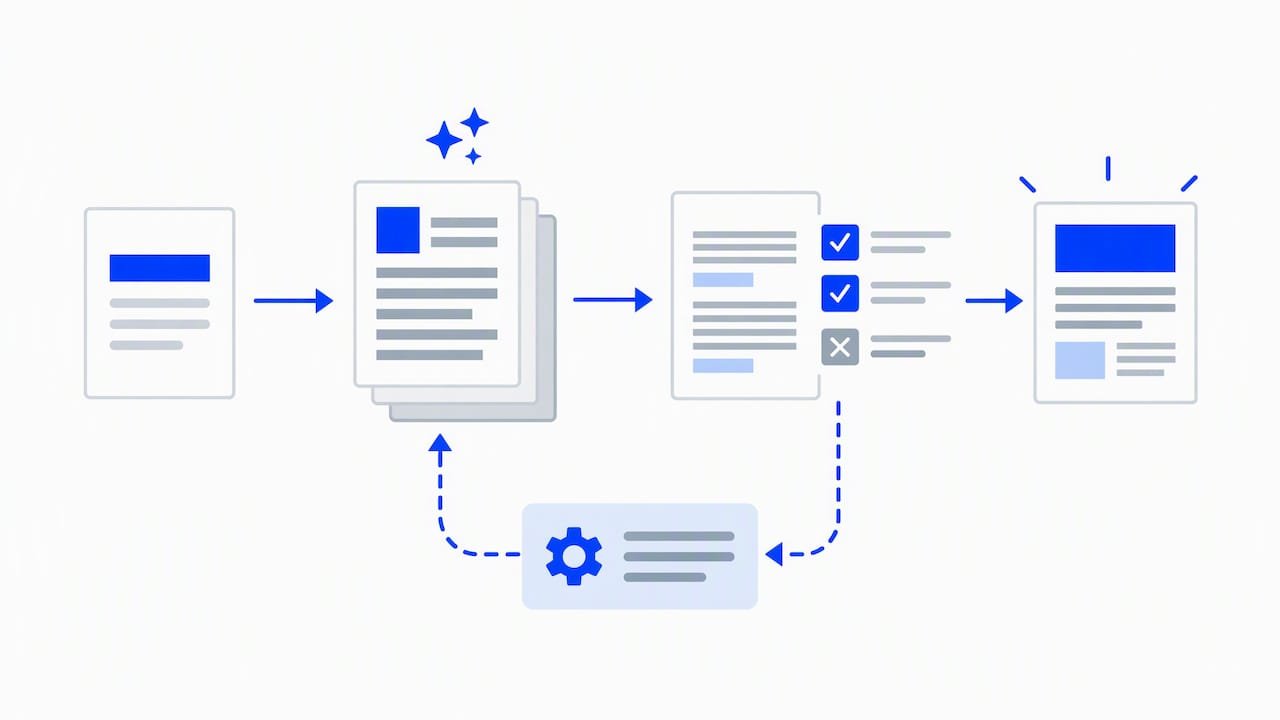
Build a prompt library from what actually works. When you edit an AI draft and fix a recurring issue, like a flat opening line or a missing source, save that correction as a new prompt instruction so the next draft improves automatically. Over several issues, this turns into a genuinely repeatable writing loop rather than a one-off trick. Content strategy guidance can help you sequence this kind of system building instead of improvising it issue by issue.
Reserve AI for the segments where speed matters most, like first-draft news summaries or tool descriptions, and keep case studies, interviews, and anything requiring real judgment mostly in your own hands. That split protects the parts of your newsletter that build the most trust.
8. Using AI Tools to Automate Creation and Personalization
Automation works best when it handles repetitive structure and leaves judgment calls to you. Use AI to generate first-draft outlines from your weekly notes, batch-draft recurring segments like “tool of the week,” and personalize subject lines based on a subscriber’s past clicks or declared interests.
A prompt library gives you a reusable set of instructions for each recurring segment, which can help you avoid starting from a blank prompt every issue. Pair that with AI brief templates so each segment has a consistent structure before AI ever touches it.
Personalization tools can also segment your list by engagement level, sending a shorter version to skimmers and a longer version to subscribers who click through every issue. The goal is matching effort to the segments that move the newsletter forward, not automating everything simply because the tool makes it possible.
9. Analyzing AI Newsletter Performance Metrics to Optimize Engagement
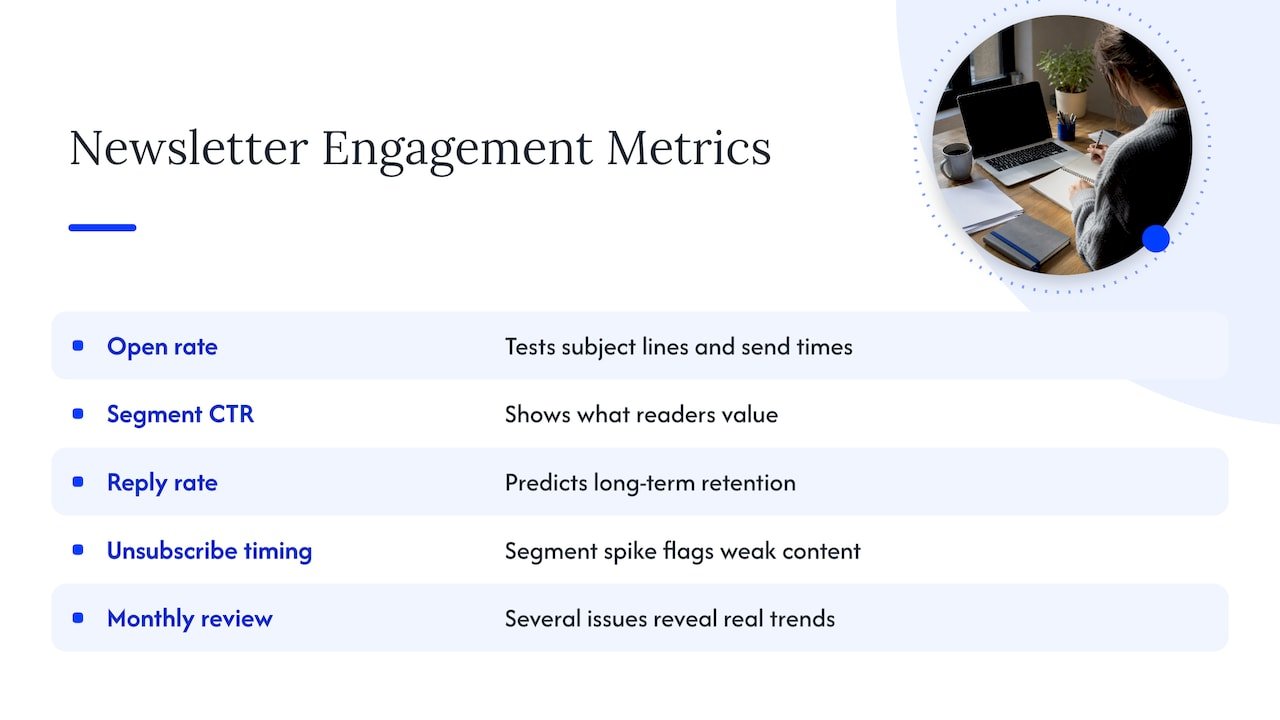
Open rate tells you whether your subject lines and send times are working, but click-through rate on specific segments tells you what readers actually value. If your “tool of the week” segment consistently outperforms your news roundup, that’s a signal to expand it, not a coincidence to ignore.
Reply rate matters more than most creators realize, especially for segments like “subscriber challenge,” because replies indicate the kind of engagement that predicts long-term retention better than a passive click. Track unsubscribe timing too: a spike after a specific segment type suggests that content isn’t earning its place in the issue.
Reviewing AI marketing analytics on a monthly basis, rather than issue by issue, helps you spot real trends instead of reacting to normal week-to-week noise. Compare performance across several issues before deciding a segment isn’t working.
10. Legal and Ethical Considerations for AI Content in Newsletters
Disclosure matters whenever AI assists in drafting newsletter content that includes affiliate recommendations. Readers deserve clarity on when a tool review was AI-assisted and when an opinion is entirely human, and clear affiliate disclosure examples give you language you can adapt rather than drafting from scratch.
Fact-checking carries extra weight when AI drafts the first pass of a research summary, since a model can misstate a finding with total confidence. Verify every number against its original source before it reaches subscribers, especially in segments like “research highlight” that readers treat as reliable shorthand for the full paper.
Governance frameworks are also catching up to this shift. Mapping your newsletter’s AI use against frameworks like NIST, IAB, and UNESCO guidance gives you a defensible standard to point to if a reader or partner ever questions how content gets made. The World Economic Forum’s Future of Jobs Report 2025 notes that AI and big data rank among the fastest-growing skills employers are investing in, which means readers increasingly expect the newsletters they follow to model responsible AI use, not just report on it.
What Actually Makes Marketer-Focused AI Newsletters Work
Marketing audiences share and click on specifics, not summaries. A segment naming one tool, one metric, and one result outperforms a general AI news roundup almost every time, because the reader can act on it the same day. Growth guidance can help you think about engagement gains for newsletters in this space, which don’t necessarily involve adding more content. If you’re starting from scratch, pick one segment from this list and draft a few issues over time before worrying about the rest.
— Will
How Will Buckley’s Resources Help You Launch and Scale an AI Newsletter
We built our resources around exactly this kind of repeatable production, because a newsletter that depends on fresh inspiration every week eventually stalls. Our AI content strategy resources relate to the segments and cadence covered above, giving you ideas to work from instead of a blank page.

- Our content strategy guidance can help you turn the segment ideas above into a production schedule.
- Our prompt library guidance helps you build reusable prompts for your newsletter.
- Our growth and attribution resources can help you explore the relationship between newsletter engagement and affiliate income.
If you’d rather hand off the research, drafting, and design entirely, Contero AI’s done-for-you content service offers a human-reviewed alternative built for agencies and small teams that want AI-assisted output without managing the production themselves. We create educational content for marketers who want to keep more control over voice and strategy while still moving fast. Start with our AI content strategy resources and adapt them to whichever segments from this list fit your audience best.
FAQ
What are some big ideas in AI?
Coverage generally centers on agentic AI and automation, generative content tools, AI regulation and governance, AI skills and workforce impact, and industry-specific AI applications like healthcare or ecommerce. Organizational adoption reached 88% by 2026 according to the 2026 AI Index Report, which is why newsletters increasingly cover workplace impact alongside raw model news.
What are some good content ideas for my newsletter?
Strong recurring segments include a tool-of-the-week mini-review, a research highlight with a few takeaways, a mini playbook with action steps, and a subscriber challenge that invites replies. Pairing one news segment with one practical segment per issue tends to keep both casual and dedicated readers engaged.
Which AI is best for project ideas?
No single tool is best for every project; the right choice depends on whether you need writing assistance, research summarization, or workflow automation. Our best AI writing tools roundup compares several options worth testing against your specific newsletter workflow.
What is the 30% rule for AI?
There’s no single standardized “30% rule” for AI that applies universally across industries or platforms. If you’ve seen this referenced for a specific context, like a platform’s content policy or a disclosure guideline, check that source directly, since the definition varies by where it’s applied.
Sources
- Hai
- Future of Jobs Report 2025: 78 Million New Job Opportunities by 2030 but Urgent Upskilling Needed to Prepare Workforces > Press releases | World Economic Forum
- AI Agents Push Humans Out of the Loop